

![[OUTSTANDING ROLE MODELS] PROF. ĐẶNG VINH QUANG: FROM THE DREAM OF RURAL ELECTRIFICATION TO AN UNYIELDING SCIENTIFIC JOURNEY](https://en.hcmus.edu.vn/wp-content/uploads/2026/02/612012545_1287411570086636_4626842991711159441_n.jpg "612012545_1287411570086636_4626842991711159441_n")
Prof. Đặng Vinh Quang at the decision-granting ceremony.
Born and raised in a rural area lacking electricity, Prof. Đặng Vinh Quang entered the world of science with a humble aspiration: to bring light to his hometown. On this challenging path, science for him is not merely about international publications or modern laboratories; it is a testament to patience, integrity, and the enduring belief that: “Nothing is impossible.”
* Sir, what was the initial catalyst that led you toward the path of scientific research?
In the early 2000s, when I was in secondary school, my local area was very poor and still lacked domestic electricity. Solar panels were not yet commonplace, appearing only in films or the press. I began my scientific pursuit driven by a ‘childish’ ambition: to develop solar cells to bring power to my community. When pursuing my Master’s, I chose Radio Physics and Electronics because I believed this path could fulfil that early dream. At that time, my family home still had no power. These everyday aspirations shaped my research journey, eventually leading me to choose optical sensors as the field most compatible with my abilities.
* Looking back, what experiences have left the most lasting impact on you?
At every stage, I have been influenced by different mentors. My primary and secondary teachers laid the foundation, sparking my curiosity through elegant mathematical problems and explanations of natural phenomena. In high school, I vividly remember my physics teacher demonstrating a copper electroplating experiment using an old battery core and a crude plastic cup. Replicating that success at home taught me that scientific research is not necessarily esoteric; it can originate from the most mundane, everyday objects. At university and postgraduate levels, my professors helped me dive deeper and form a methodical scientific mindset.
* During your years of teaching and research, what makes you feel the true significance of your profession?
Teaching taught me that my research experience could make lectures more vivid and persuasive. I design lessons around simple experiments to substantiate theories; consequently, students grasp issues more effectively and gain confidence in both scientific knowledge and their mentor. For me, the moment a student truly ‘comprehends the problem’ is when I feel the profound significance of both science and pedagogy.
I still recall an afternoon when I was quite stern with a student following an experimental error. After they left in tears, I returned to the lab. Around 7 PM, the student suddenly rushed back, breathless, holding a loaf of bread. They said, “Please eat this, Lecturer; I noticed you haven’t eaten since this afternoon.” Sitting on a stone bench sharing that simple meal was a moment of pure humanity that made me love this profession deeply.
* Upon returning to Viet Nam, what challenges and turning points did you encounter?
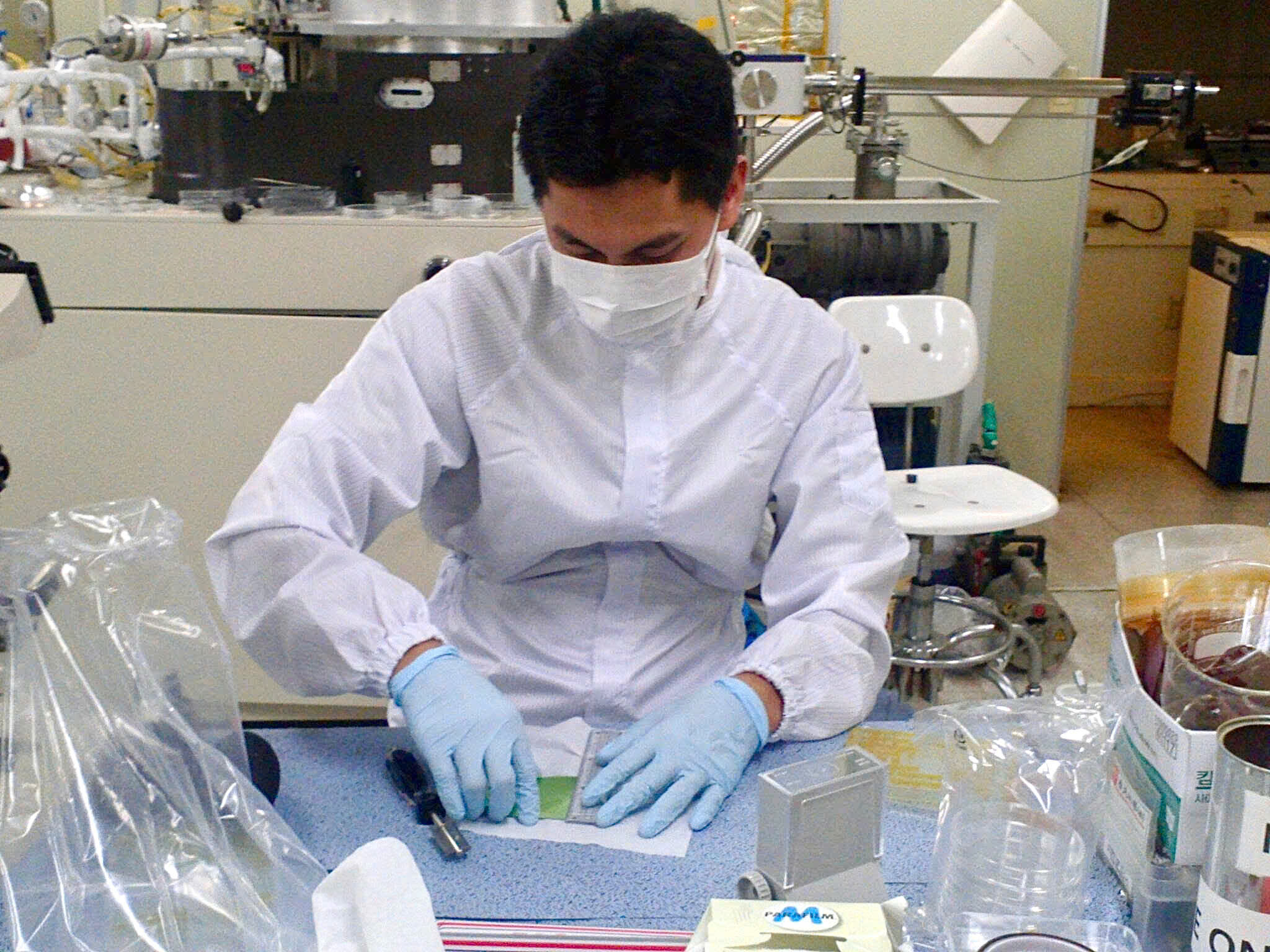
Returning to work at HCMUS after my tenure in South Korea was a period of transition. In Korea, everything—from chemicals to advanced instrumentation—was readily available. Returning to Viet Nam meant starting from scratch: procuring chemicals, securing measurement facilities, and building a laboratory. There were moments of profound uncertainty when I contemplated giving up. What sustained me was the unwavering support from colleagues and the collaboration of my students. That first Nafosted grant gave me the necessary experience in project management, serving as a premise for my subsequent research directions in Viet Nam.
* Reflecting on your journey and your recognition as an Associate Professor in 2025, what message do you wish to convey?
Among my research interests, I have remained most committed to optical sensors. There were periods when my team and I stayed up for nights on end, living in a different time zone to the rest of the world. My proudest work remains the publication on UV light sensors based on ZnO nanowires and CVD Graphene in the journal Small (Wiley).
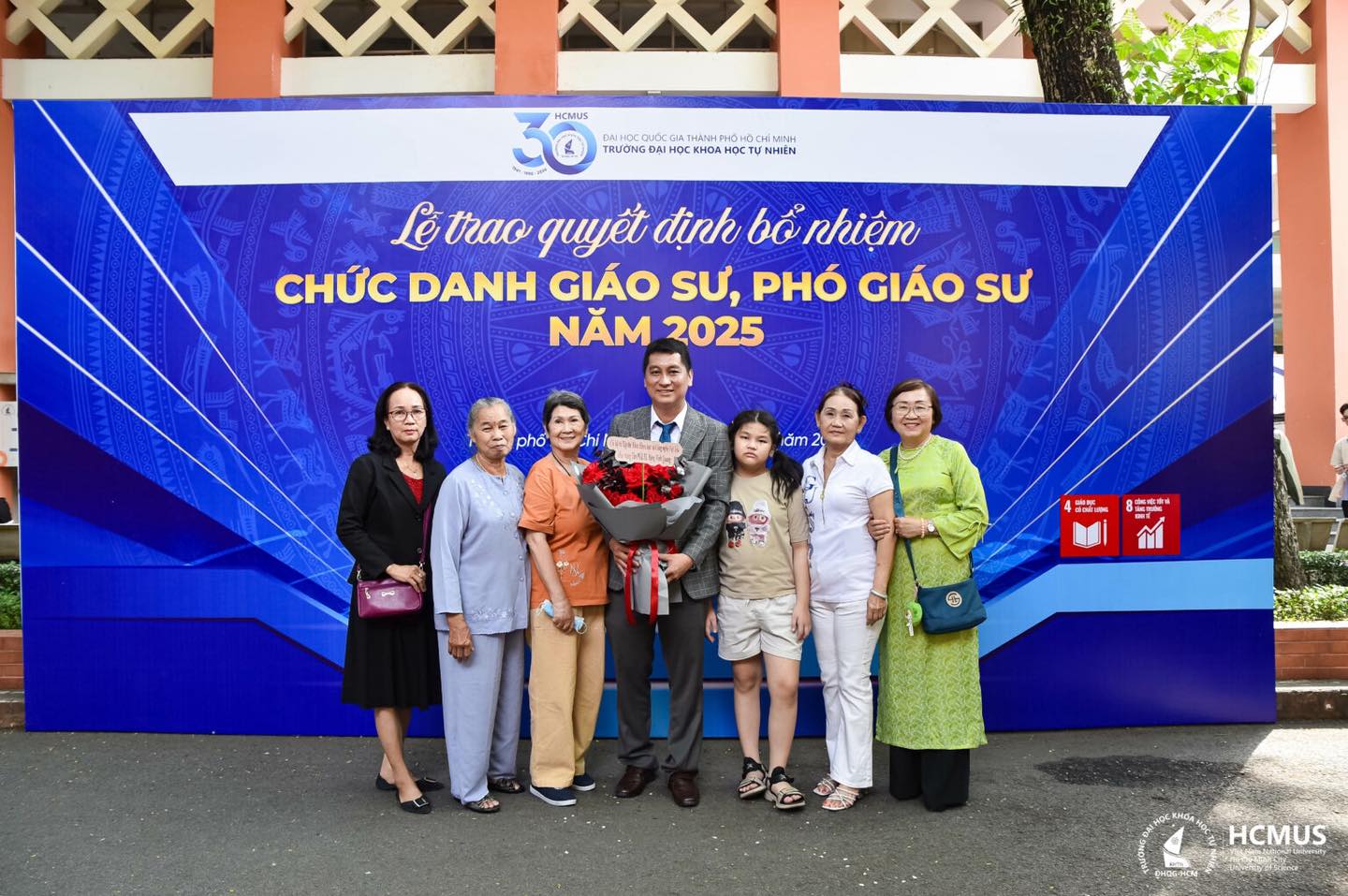
My philosophy remains: “Nothing is impossible.” To succeed, one must never surrender. Furthermore, scientific integrity is paramount; because science is cumulative, any form of deception would undermine the entire academic foundation. Being recognised as an Associate Professor in 2025 brings me great joy—it validates the years of collective effort and fulfils a personal promise to leave my children the most prestigious ‘CV’ possible.
Biographical Sketch
Prof. Đặng Vinh Quang (b. 1984) is currently a lecturer at the Faculty of Materials Science and Technology, HCMUS. He was trained at Can Tho University (B.Sc.), HCMUS (M.Sc.), and received his Doctorate from Sungkyunkwan University (South Korea) in 2016. He notably served as a Research Professor at Korea University before returning to Viet Nam. In 2025, he was officially recognised as an Associate Professor.
In his scientific journey, Prof. Đặng Vinh Quang focuses on the fabrication of optical sensors and SERS substrates for detecting low-concentration organic toxins. These efforts have resulted in 52 scientific papers (40 in ISI journals), 2 patents/utility solutions, and contributions to Springer academic book chapters. Having led numerous ministerial-level projects and received a Postdoctoral Fellowship from the Vingroup Innovation Foundation (VINIF), he continues to contribute significantly to the training of high-quality materials science personnel in Viet Nam.
Leave a Reply