

![[DOCTORAL THESIS DEFENCE] DOCTORAL RESEARCHER LÊ HOÀNG MINH SUCCESSFULLY DEFENDS DOCTORAL THESIS ON IRON OXIDE-DOPED CONCRETE FOR GAMMA RADIATION SHIELDING](https://en.hcmus.edu.vn/wp-content/uploads/2026/09/Vatly-14-scaled.jpg "Vatly (14)")
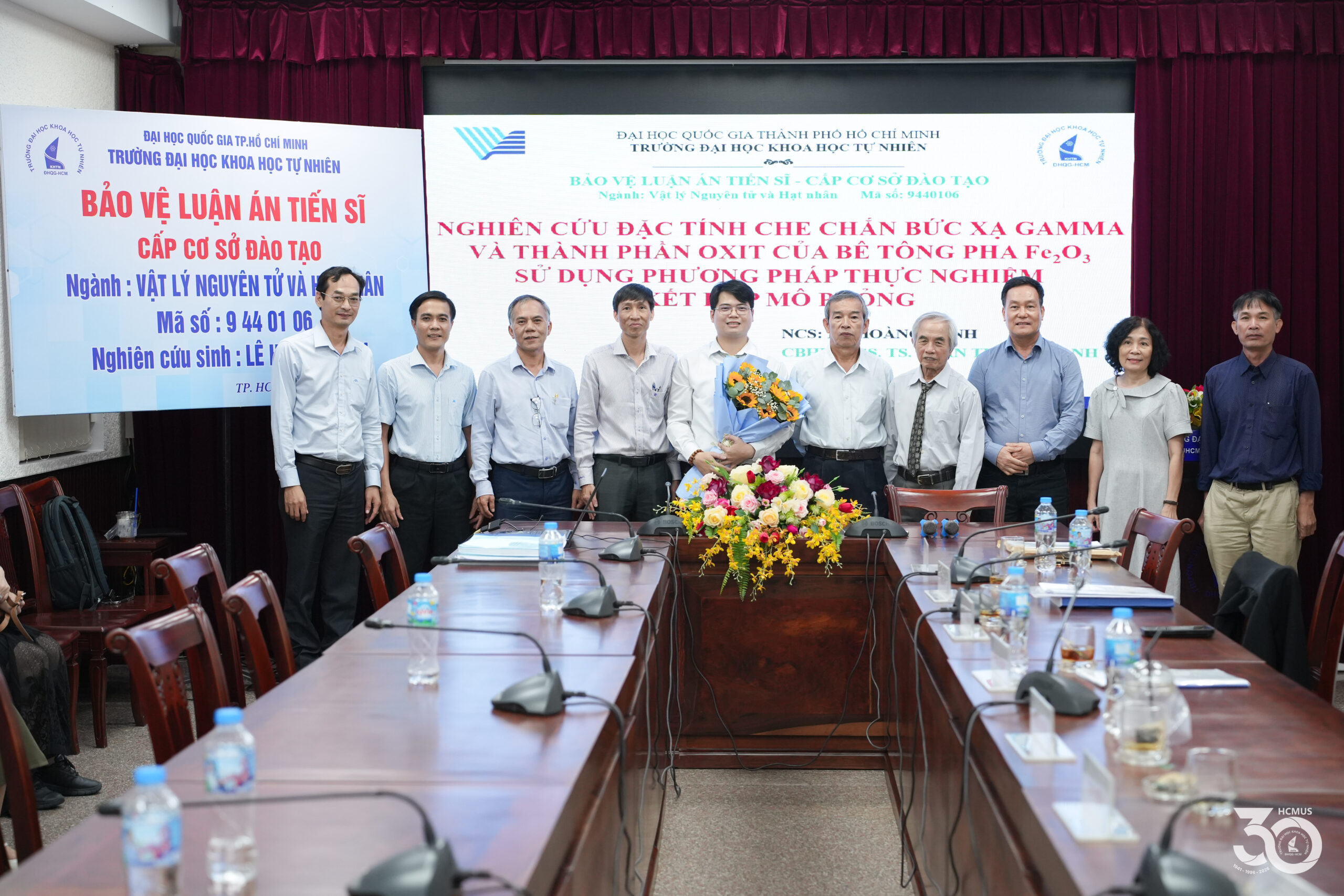
On 22 August, at VNUHCM–University of Science (HCMUS), doctoral researcher Lê Hoàng Minh successfully defended a doctoral thesis in Atomic and Nuclear Physics entitled ‘Investigation of gamma radiation shielding characteristics and oxide composition of Fe2O3-doped concrete using combined experimental and simulation methods’. The research was conducted under the scientific guidance of Associate Professor Trần Thiện Thanh.
In the context of increasingly widespread applications of nuclear techniques and ionizing radiation across medicine, industry, and research, developing safe, effective, and cost-efficient shielding materials plays an exceptionally crucial role. Heavy concrete represents a common solution; however, improving material density and radiation absorption capacity whilst maintaining mechanical strength poses a scientific challenge requiring rigorous experimental and simulation approaches.
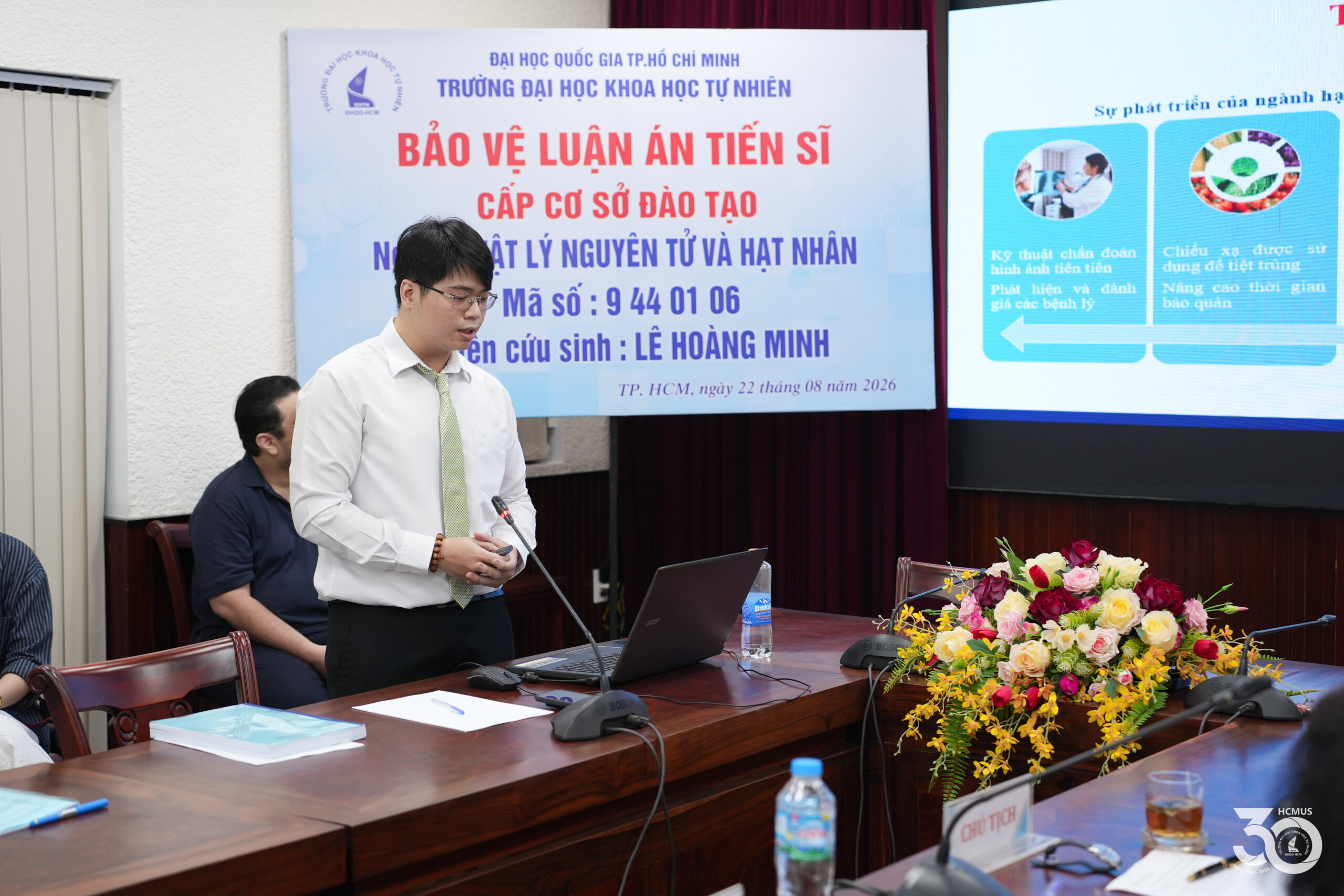
To address this challenge, the study investigated the gamma radiation shielding properties of heavy concrete doped with iron oxide (Fe2O3), which progressively replaced sand. The project comprehensively evaluated characteristic parameters including material density, linear attenuation coefficient, and effective atomic number (Zeff). Experimental procedures utilized a NaI(Tl) scintillation detector system for transmission gamma measurements and a Si(Li) semiconductor detector system for Rayleigh-to-Compton (R/C) scattering measurements. Integrating Monte Carlo simulation via the MCNP-CP program eliminated small-angle scattering effects, reducing the deviation rate of the linear attenuation coefficient compared to theory from 3–6% to 0–3%.
Experimental results confirmed that iron oxide-doped concrete enhances shielding efficiency against low-energy radiation by up to 19% whilst maintaining compressive strength to B15 standards, ensuring technical suitability for practical application in radiation safety construction. Crucially, the thesis successfully established a non-destructive method based on the R/C scattering ratio to determine precisely the material composition within metal oxide powder mixtures with an error below 8%. Principal Component Analysis (PCA) conducted on 26 specialized concrete types further demonstrated that density, iron content, and effective atomic number serve as the key factors governing shielding performance.
The research opens up strong potential applications across institutes, centers, and laboratories for testing radiation safety materials. The proposed R/C scattering technique acts as an effective complementary solution to standard analytical methods such as XRF or XRD. Looking ahead, the project aims to expand the analysis of mechanical properties (flexural strength, slump) and verify findings across more complex material systems.
Leave a Reply