

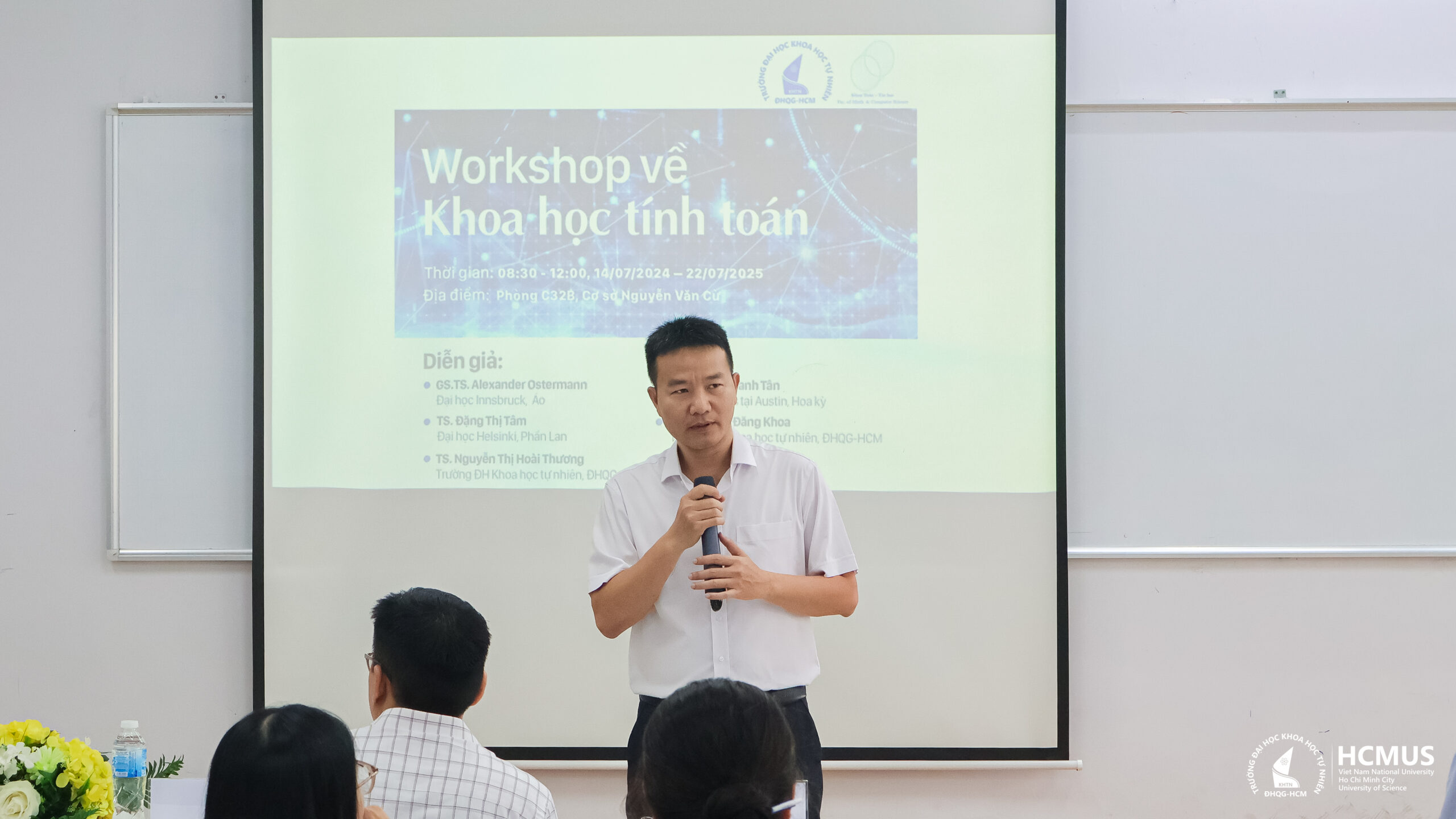
Dr Võ Đức Cẩm Hải, Vice Dean of the Faculty of Mathematics and Computer Science, VNUHCM-University of Science, delivering the opening remarks of the workshop.
The Workshop on Computational Science took place from 14 to 22 July at VNUHCM-University of Science (HCMUS), under the coordination of the Faculty of Mathematics and Computer Science, with the participation of Vietnamese researchers and researchers from Austria, Finland, and the United States.
This significant academic initiative contributed to enhancing research collaboration, updating participants on advanced computational methods, and expanding professional networks among lecturers, researchers, and students.
A Multidimensional International Forum for Academic Exchange
The workshop featured keynote lectures by leading international experts from prestigious institutions, including Prof. Alexander Ostermann (University of Innsbruck, Austria), Prof. Bùi Thanh Tân (University of Texas at Austin, United States); and Dr Đặng Thị Tâm (University of Helsinki, Finland); alongside lecturers and academic staff of the Faculty of Mathematics and Computer Science.
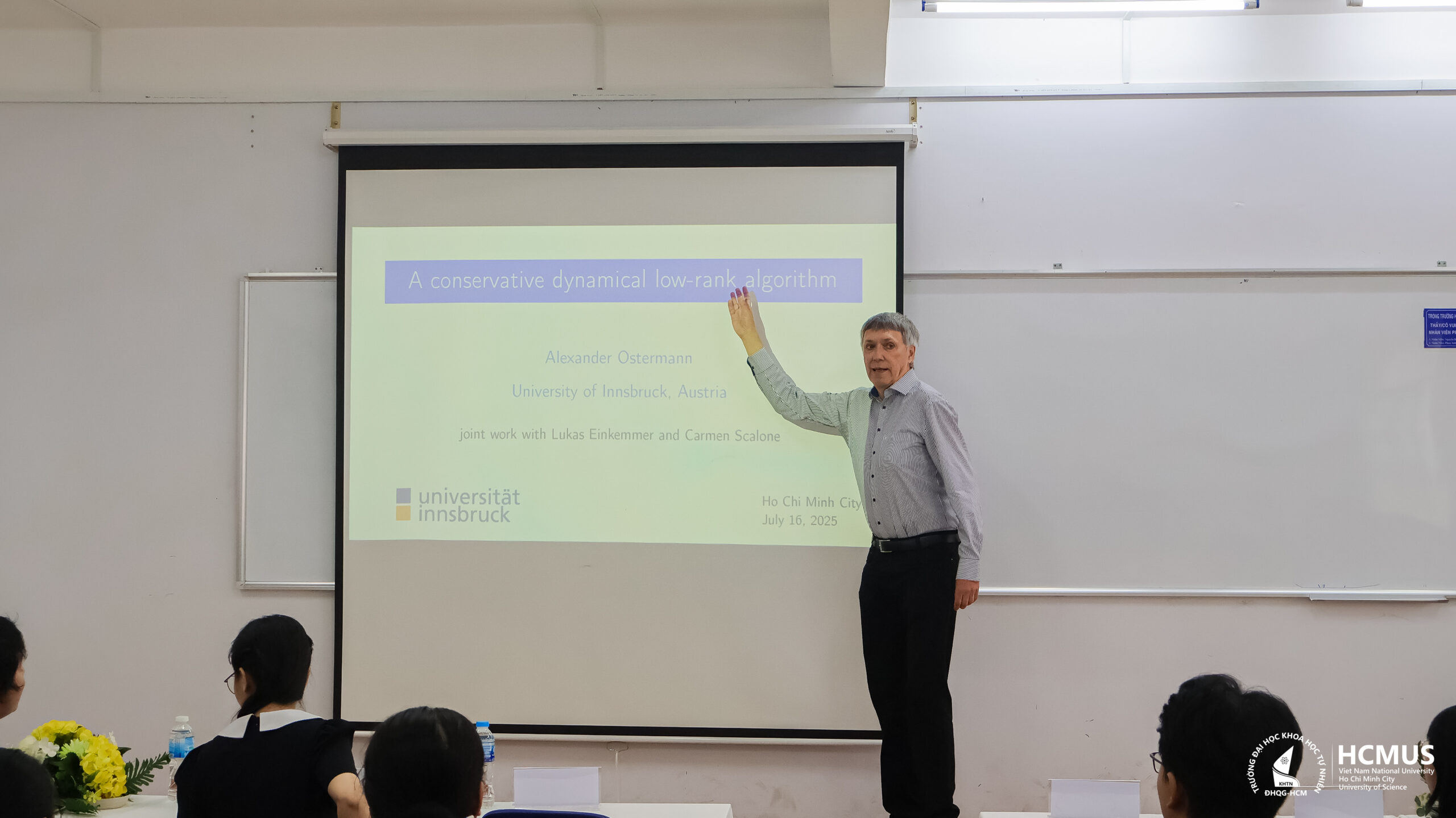
From 14 to 16 July, Prof. Alexander Ostermann delivered an intensive lecture series on Exponential Integrators – a modern class of integration methods particularly effective for stiff differential equations. The lectures addressed fundamental principles, computational challenges, acceleration techniques, operator splitting, and practical applications in scientific computing, enabling participants to access advanced techniques directly relevant to the field.
Thematic Seminars – Engaging with Emerging Research Directions
In addition to the lecture series, the workshop included several thematic seminars introducing contemporary research directions and encouraging scholarly exchange from diverse perspectives:
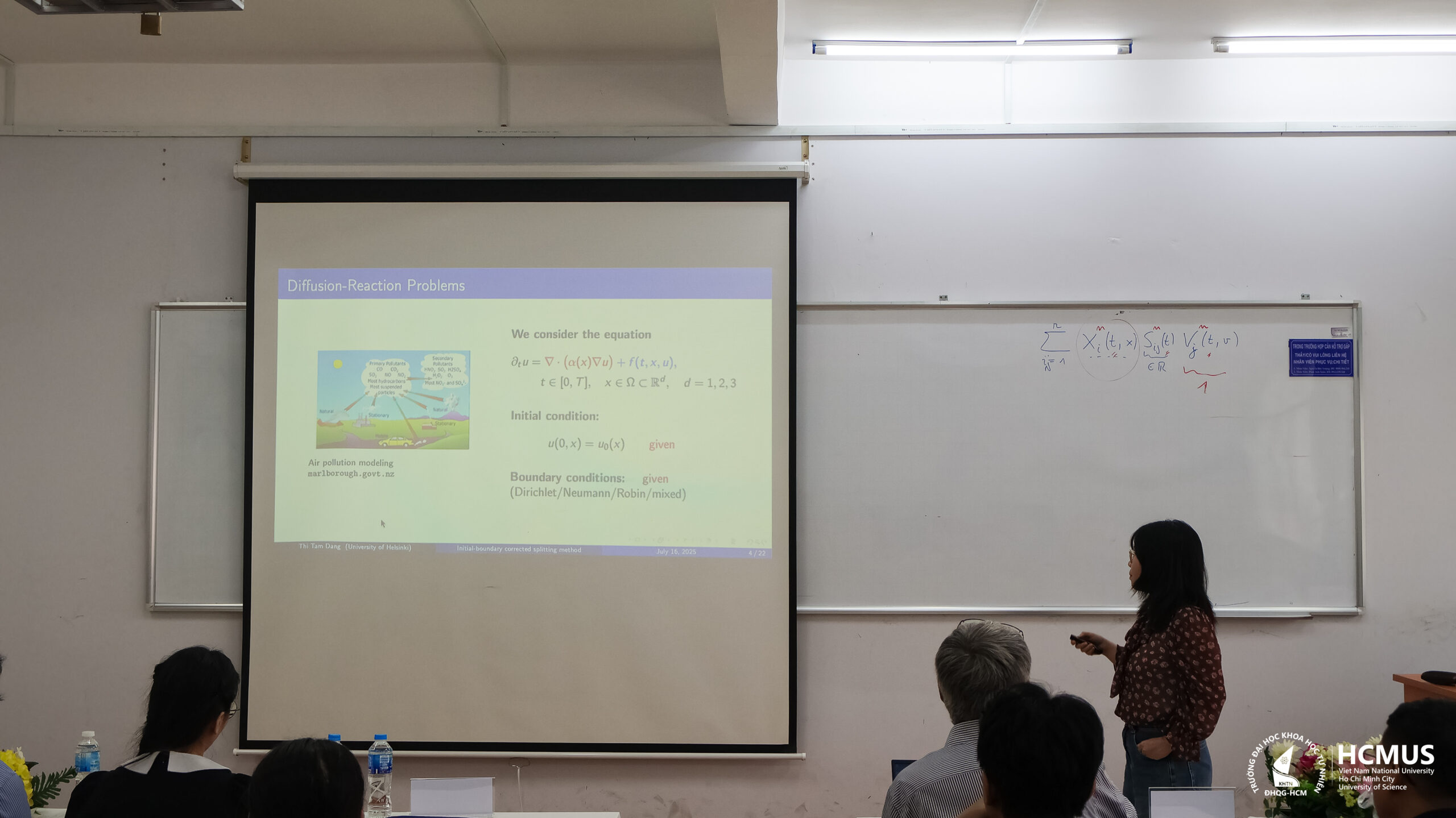
– Dr Đặng Thị Tâm (University of Helsinki) presented “An initial-boundary corrected splitting method for diffusion-reaction problems”, proposing a novel splitting approach that overcomes convergence order degradation often observed in classical splitting methods under Dirichlet boundary conditions. The method does not require boundary-dependent correction terms, yet achieves higher accuracy and computational efficiency, offering a practical solution for simulating diffusion–reaction phenomena in complex physical domains.
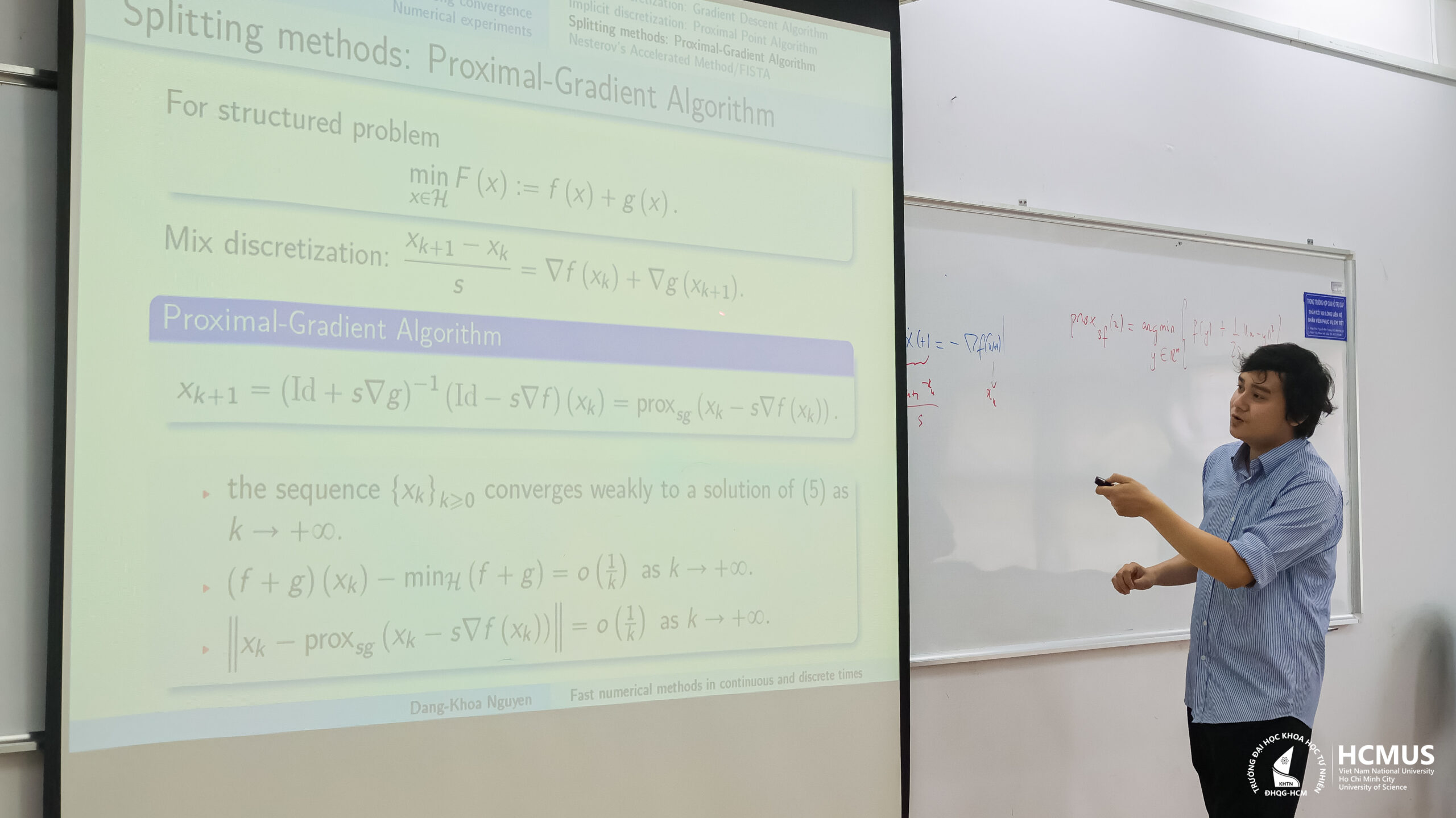
– Dr Nguyễn Đăng Khoa, Department of Analysis (Faculty of Mathematics and Computer Science, HCMUS), delivered the talk “Fast numerical methods for monotone operator in continuous and discrete times”. The research focused on second-order dynamical systems in Hilbert spaces to address the zero-finding problem of monotone operators – a core issue in optimisation. Based on this framework, discrete schemes with fast convergence were developed, retaining favourable properties from the continuous model and incorporating Tikhonov regularisation to ensure strong convergence to the minimal norm solution. The work offers valuable contributions to solving optimisation problems in large-scale and high-dimensional environments.
– Dr Nguyễn Thị Hoài Thương, Department of Analysis (Faculty of Mathematics and Computer Science, HCMUS), presented “A stiffly stable semi-discrete scheme for the damped wave equation using SBP and SAT techniques”. The study developed a stable semi-discrete scheme for the damped wave equation in the half-plane, applying the Summation-by-Parts (SBP) and Simultaneous Approximation Term (SAT) techniques. Compatibility with the stiff Kreiss condition was also examined to ensure global boundary stability. This research supports more reliable simulation of wave propagation in domains with complex physical boundaries.
– Prof. Bùi Thanh Tân (University of Texas at Austin) introduced “Learn2Solve: A Deep Learning Framework for Real-Time Solutions of Forward, Inverse, and UQ Problems”. The presentation outlined a scientific deep learning platform capable of providing real-time solutions to forward, inverse, and uncertainty quantification problems. The framework was demonstrated on a range of physical models, from fundamental to complex, including transport, heat, Burgers, Euler (supersonic and subsonic), and Navier–Stokes equations. This approach demonstrates the potential of artificial intelligence in simulating complex physical systems and expanding the capabilities of computational science in engineering and data analysis.
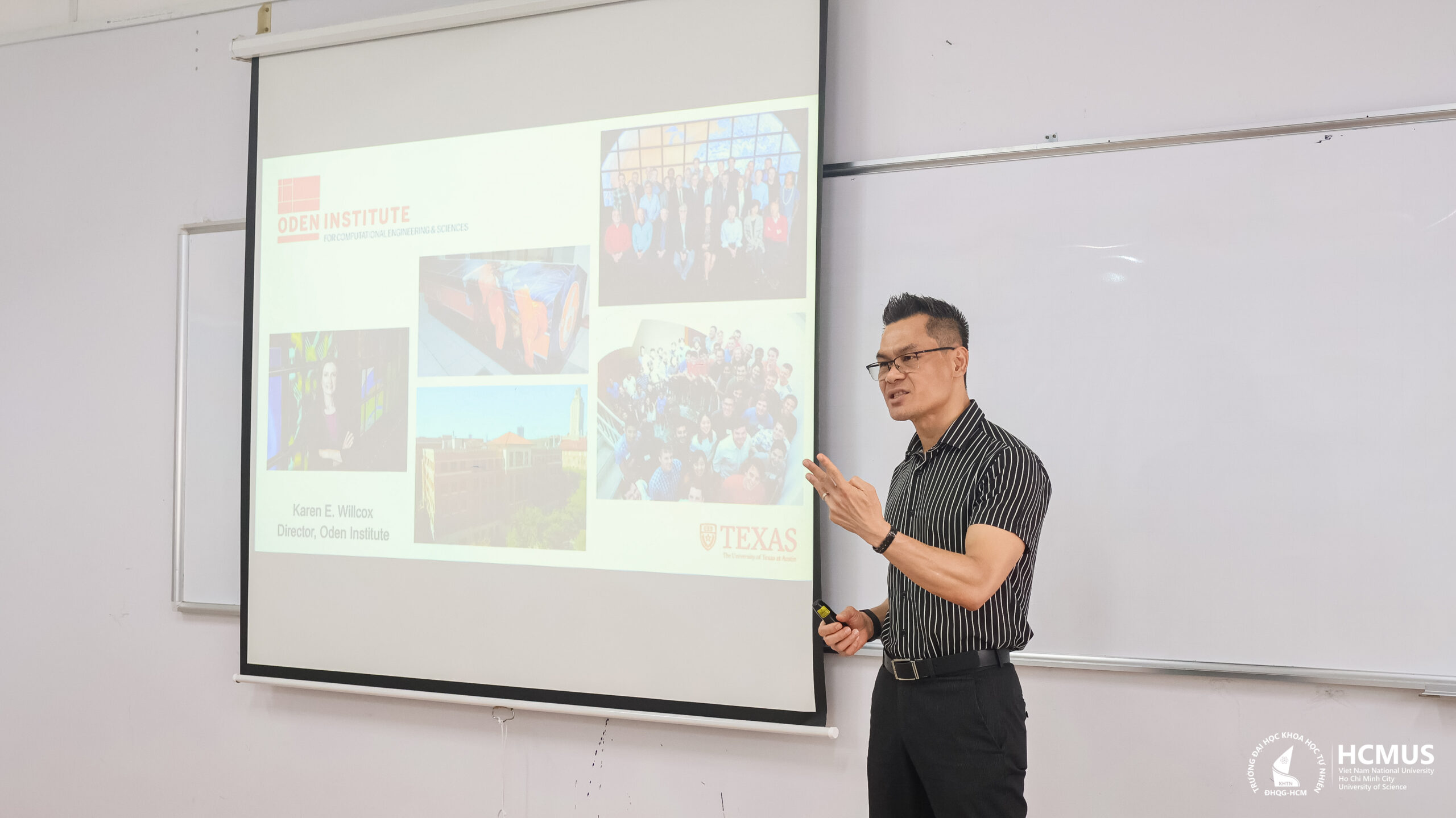
Advancing Expertise – Towards Sustainable Research Development
The workshop offered valuable opportunities for lecturers and learners to strengthen academic expertise, engage with modern research methods, and connect with international scholars. Participants were also able to define clearer research directions and explore academic programmes, scholarships, and collaboration opportunities with global institutions.
The event formed part of the broader strategy of the Faculty of Mathematics and Computer Science and VNUHCM-University of Science to improve training and research quality – particularly in applied mathematics and computational science, both of which play increasingly critical roles in interdisciplinary scientific development and digital transformation.

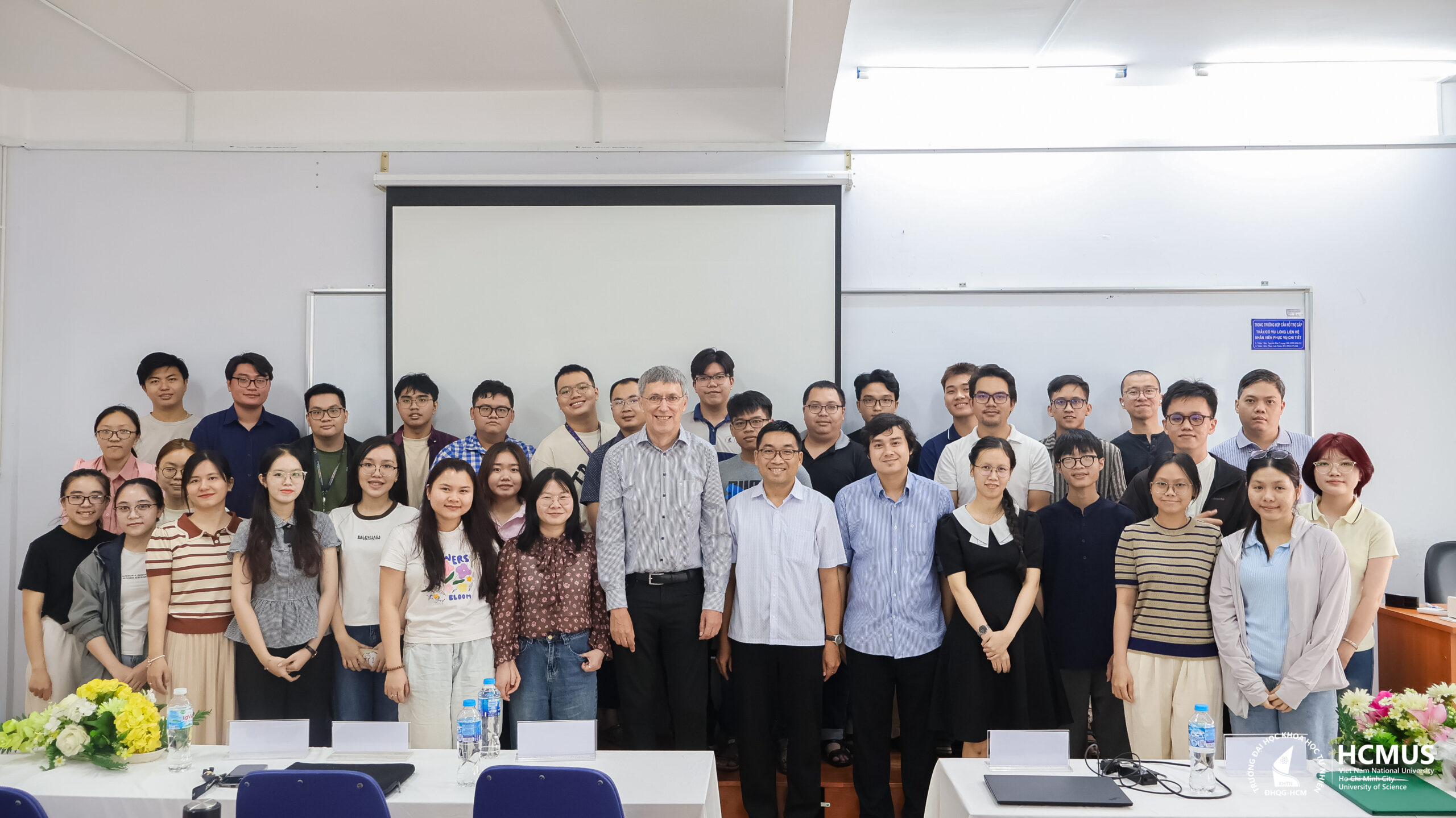
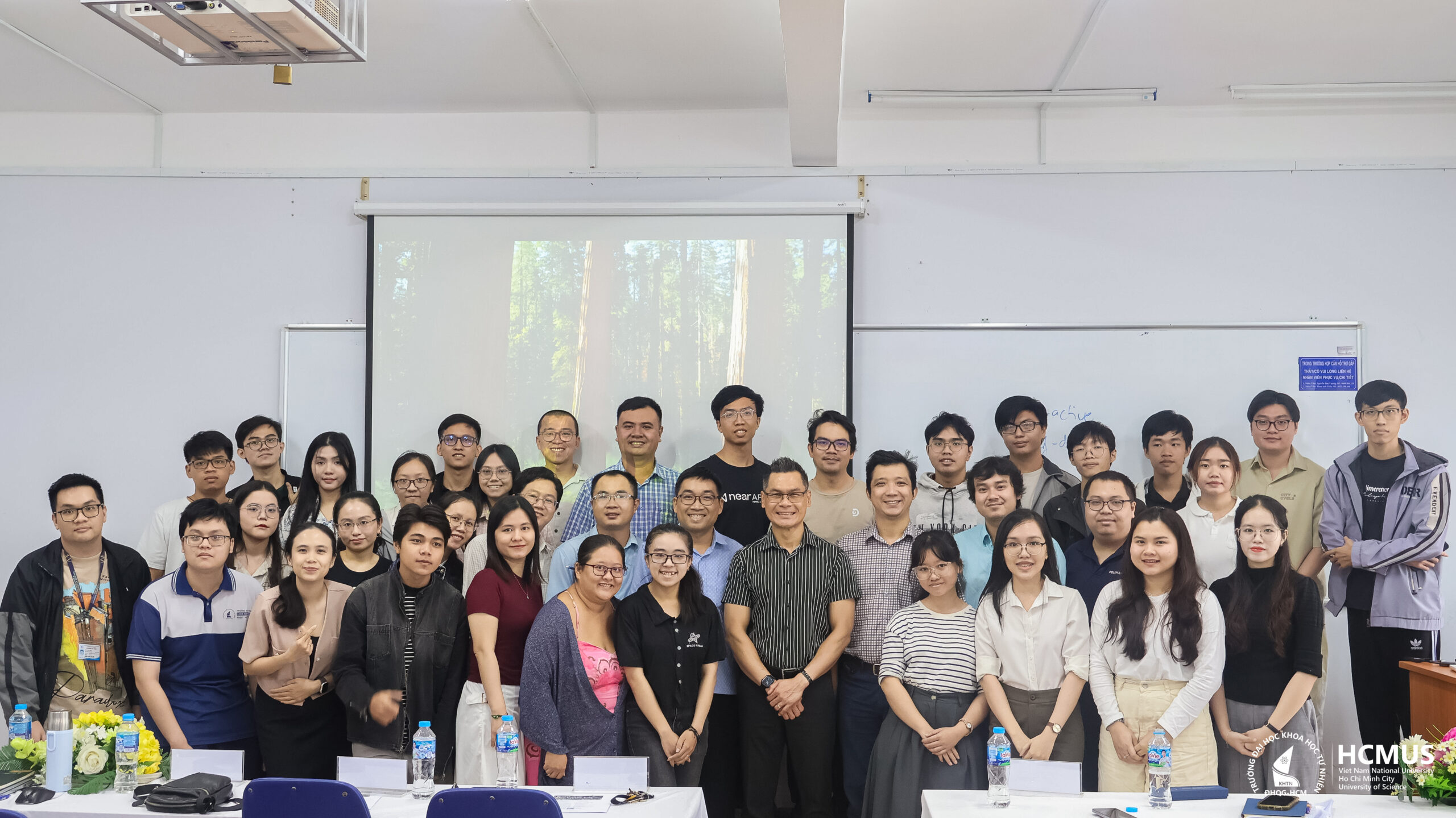
Delegates and speakers posing for group photographs at the Computational Science Workshop.
PMN
Leave a Reply