

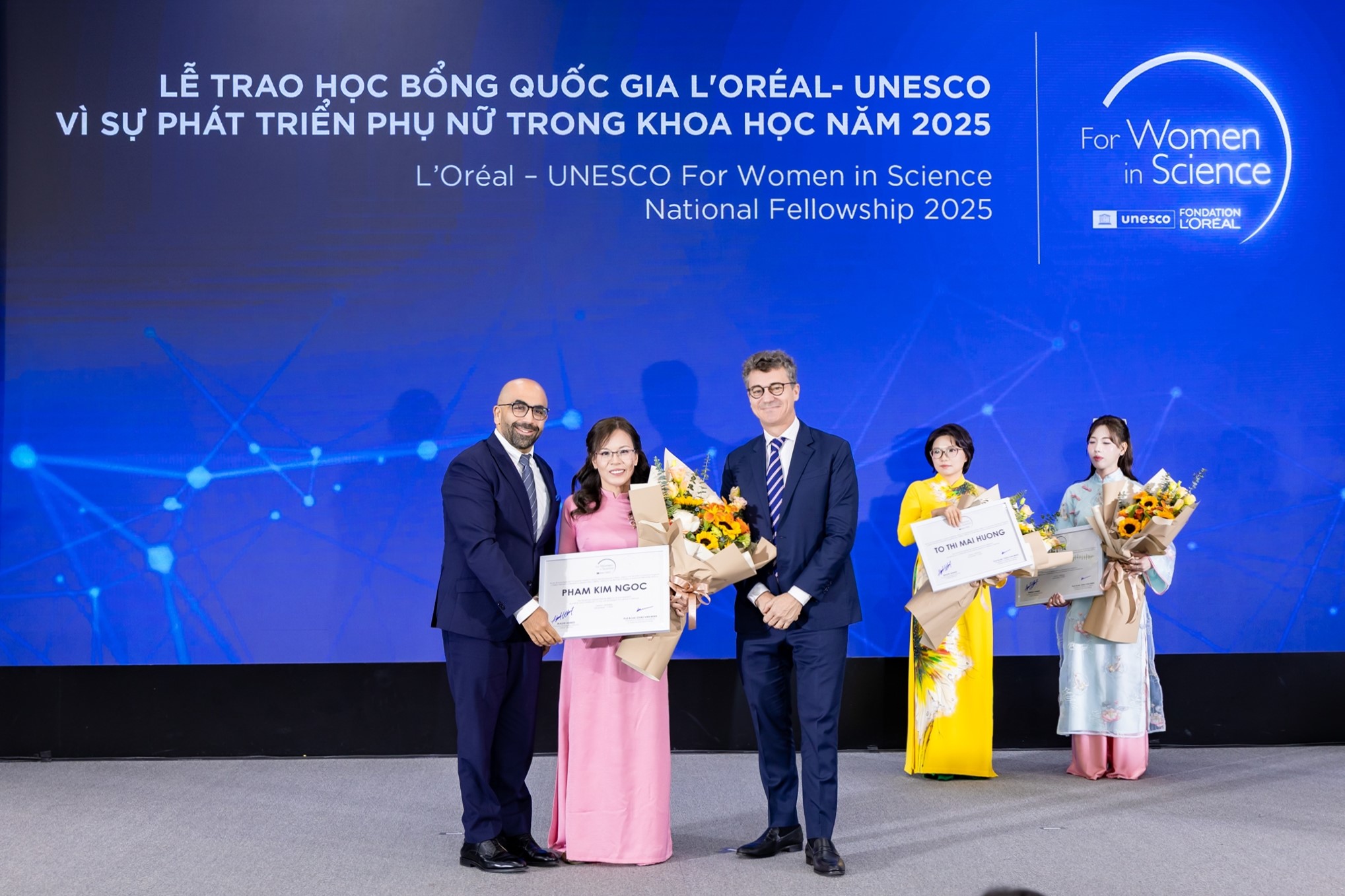
On 1 December in Ha Noi, the L’Oréal–UNESCO ‘For Women in Science’ programme presented national fellowships valued at 150 million VND to three distinguished Vietnamese female scientists. Among the laureates, Assoc. Prof. Phạm Kim Ngọc (Faculty of Materials Science and Technology, VNUHCM-University of Science) received acclaim as a prominent figure for pioneering research into semiconductor devices and nanomaterial structures.
Amidst the rapid progression of Artificial Intelligence (AI), traditional computing infrastructure is approaching a critical overload point. The conventional von Neumann architecture, relying upon the separation of processing units from memory, creates a data ‘bottleneck’. Such a limitation results in significant energy wastage and decelerates the AI training process. Consequently, developing AI systems capable of mimicking brain activity—operating with greater speed and energy efficiency—stands as a paramount challenge in modern science and technology.
Addressing these practical demands, the project titled “Research and Fabrication of Memristor Devices and Circuits for Application as Artificial Synapses in Neuromorphic Computing Systems,” led by Assoc. Prof. Phạm Kim Ngọc, garnered high commendation from the Scientific Council for novelty and applicability.

The investigation explores breakthrough solutions in In-Memory Computing (IMC) architecture. A central focus remains the use of memristors—electronic components capable of storing analogue states, mimicking biological synapses, and allowing for high integration within crossbar arrays. To enhance reliability, Assoc. Prof. Phạm Kim Ngọc concentrates on Self-Rectifying Memristors (SRM), constructing the study from the fundamental materials level through to device and circuit fabrication.
According to the Scientific Council, such work paves the way for realising non-von Neumann hardware AI systems. These platforms promise superior learning capabilities, parallel processing, and energy efficiency, mimicking human brain function more closely than ever before. The research serves as a foundation for developing next-generation AI chips, fostering a more powerful and sustainable era of Artificial Intelligence.
Currently serving as Head of the Department of Nanomaterials and Thin Films, Assoc. Prof. Phạm Kim Ngọc has acted as Principal Investigator for numerous ministry-level and VNUHCM-level projects. The professor’s academic portfolio includes over 50 papers in prestigious international journals, four patents, and several published monographs. Furthermore, the awardee remains dedicated to mentoring the next generation of researchers in the field of advanced materials, contributing significantly to the development of the materials science and semiconductor industries in Viet Nam.
Leave a Reply