

![[VNUHCM S&T PROJECT EVALUATION] EVALUATING NO₂ EMISSION TRENDS IN HO CHI MINH CITY USING MODELLING AND SATELLITE DATA](https://en.hcmus.edu.vn/wp-content/uploads/2026/04/P4T02681-scaled.jpg "P4T02681")
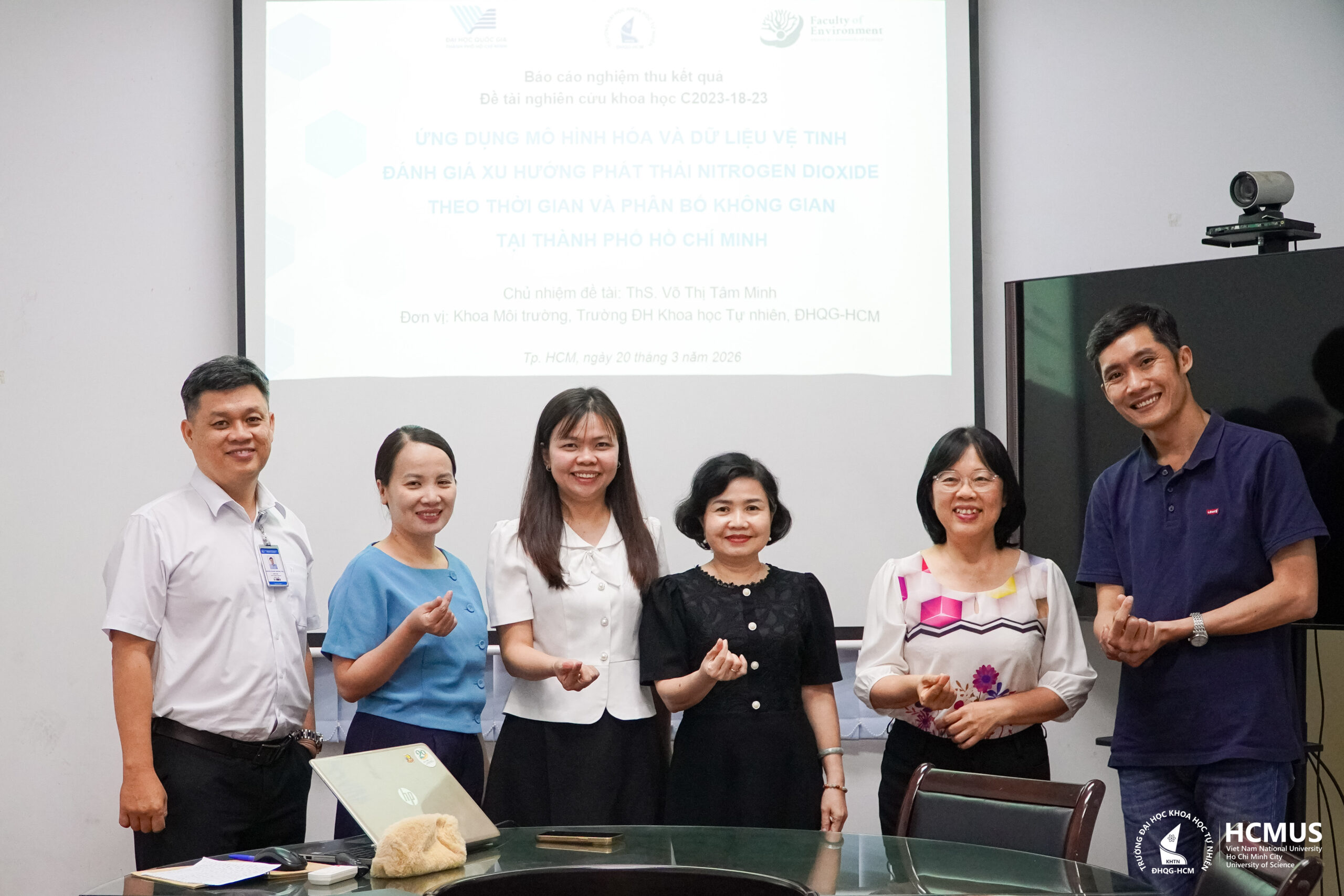
On 20 March 2026, the Council for Project Evaluation convened at VNUHCM–University of Science (HCMUS) to assess a VNUHCM-level scientific project entitled: “Application of modelling and satellite data to evaluate temporal trends and spatial distribution of nitrogen dioxide emissions in Ho Chi Minh City”. The research was led by MSc. Võ Thị Tâm Minh from the Faculty of Environment, HCMUS.
Nitrogen dioxide (NO₂) remains a critical air pollutant, capable of directly compromising environmental quality and human health when concentrations exceed permissible limits. Furthermore, NO₂ acts as a precursor to ground-level ozone and serves as a primary agent in the formation of acid rain, thereby exerting detrimental effects on ecosystems and habitats.
In an era where major metropolises face escalating atmospheric challenges, the inventory of NO₂ emissions is regarded as a fundamental necessity. Such data is of paramount importance for air quality management, particularly in regions characterised by high traffic density and intensive industrial activity.
Driven by these practical requirements, the research team conducted an evaluation of NO₂ emissions in Ho Chi Minh City—one of the nation’s largest urban centres. The city sees a significant concentration of transport, industry, and urban development, yet published emission data remains limited.

The study employed the Lifetime-Modified Accumulation Method (LMAM) in conjunction with tropospheric NO₂ column data from the OMI/Aura satellite between 2019 and 2024 to estimate temporal trends and spatial distributions.
Research findings indicate that the average NO₂ emission rate in Ho Chi Minh City reached 6.56 x 10¹⁵ molecules cm-2 h-1 in 2019, before declining to 5.79 x 10¹⁵ molecules cm-2 h-1 in 2020 due to lockdown measures implemented during the COVID-19 pandemic. The highest emission levels were recorded in urban and industrial zones, whilst lower values were observed in suburban districts.
Simultaneously, the LMAM model demonstrated a robust correlation with NOx data from the TROPESS Chemical Reanalysis (TCR), yielding correlation coefficients of r = 0.71 in 2019 and r = 0.70 in 2020. These figures reinforce the reliability of this methodology for the analysis of emission trends.

Long-term trends also clearly reflect the impact of socio-economic shifts on urban air quality: emissions fell sharply during the 2020–2021 period but recovered substantially thereafter. Levels reached approximately 1.3 x 10¹⁶ molecules cm-2 h-1 during 2023–2024 as economic activities, transport, and manufacturing resumed.
Regarding scientific output and academic training, the project achieved several notable milestones, including: one scientific article published in an SCIE – Q2 journal, the Bulletin of Environmental Contamination and Toxicology; one scientific poster presented at the 5th Sustainability Conference at the University of Akureyri (Iceland) in June 2025; and the successful supervision of two graduating students who completed their research based on these findings.
The outcomes of this study hold both academic significance and practical utility. The work provides a reference database for emission inventories, supports the assessment of the current atmospheric state in Ho Chi Minh City, and assists in the formulation of emission control policies and future urban environmental management strategies.
Leave a Reply