

![[VNUHCM S&T PROJECT EVALUATION] GREEN SYNTHESIS OF NANOMATERIALS FOR SUSTAINABLE COSMETICS](https://en.hcmus.edu.vn/wp-content/uploads/2026/01/IMG_9700-scaled.jpg "IMG_9700")
On 14 January 2026, VNUHCM–University of Science (HCMUS) convened an Evaluation Council to review a VNUHCM level science and technology project: “Synthesis of titanium dioxide nanomaterials via green chemistry for applications in the cosmetic industry”, led by Trần Mai Anh.
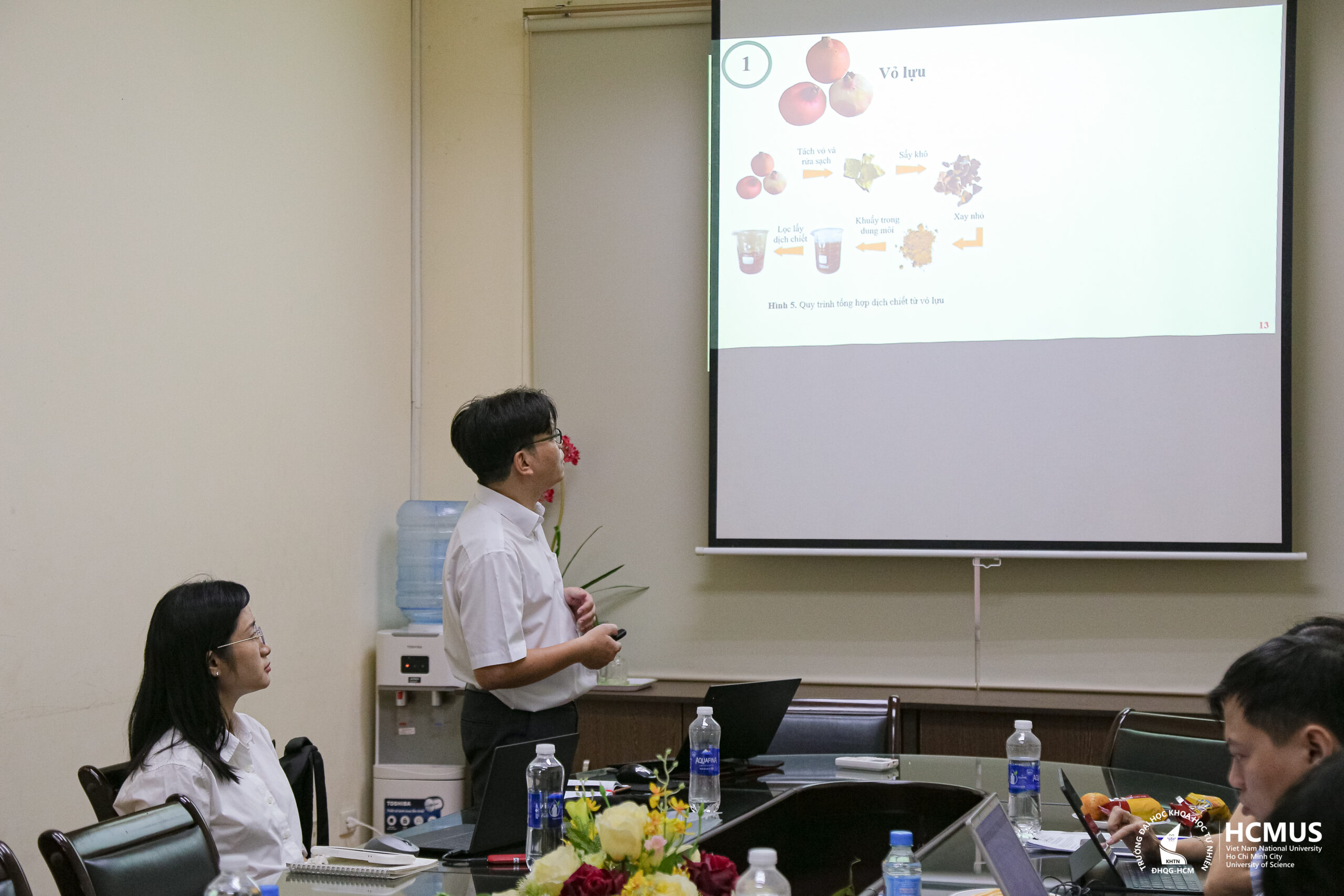
During the session, the principal investigator presented a summary of the research objectives, experimental protocols, and the achievements realised throughout the implementation period. The study focused on the synthesis of Titanium dioxide (TiO2) and Zinc oxide (ZnO) nanoparticles using green chemistry methods, leveraging eco-friendly natural extracts from aloe vera, pomegranate peel, lotus leaves, and peppermint leaves.
Experimental results demonstrated that the synthesised materials possess uniform particle sizes ranging from 11–35 nm, with morphological characteristics and crystal phases optimised for UV absorption and scattering. Notably, the research indicated that pomegranate peel extract yielded the highest efficiency in material synthesis. Regarding biosafety, tests conducted on the L929 cell line confirmed the absence of toxicity, fully satisfying the safety standards required for cosmetic ingredients.
Building upon these findings, the research team developed a sunscreen gel formula incorporating the TiO2 – ZnO nanostructures. Measurement results showed that the product maintains excellent physical stability, ensuring appropriate viscosity and spreadability. The formulation recorded promising technical indices, such as a Sun Protection Factor (SPF) of 30–37 and a PA++ rating, providing up to 97% protection against the harmful effects of UVB and UVA radiation. These figures are comparable to commercial control samples at the same active ingredient concentrations, proving the practical potential of nanomaterials synthesised through ‘green’ pathways.
In terms of scientific output and academic training, the project successfully published one scientific paper within the Scopus system and supervised four undergraduate students in the successful defence of their graduation theses.
Concluding the meeting, the Evaluation Council praised the rigorous execution of the project, the reliability of the research methodology, and the delivery of tangible outputs. The findings possess clear scientific merit and high application value, contributing to the development of safe, environmentally conscious cosmetic lines.
Leave a Reply