

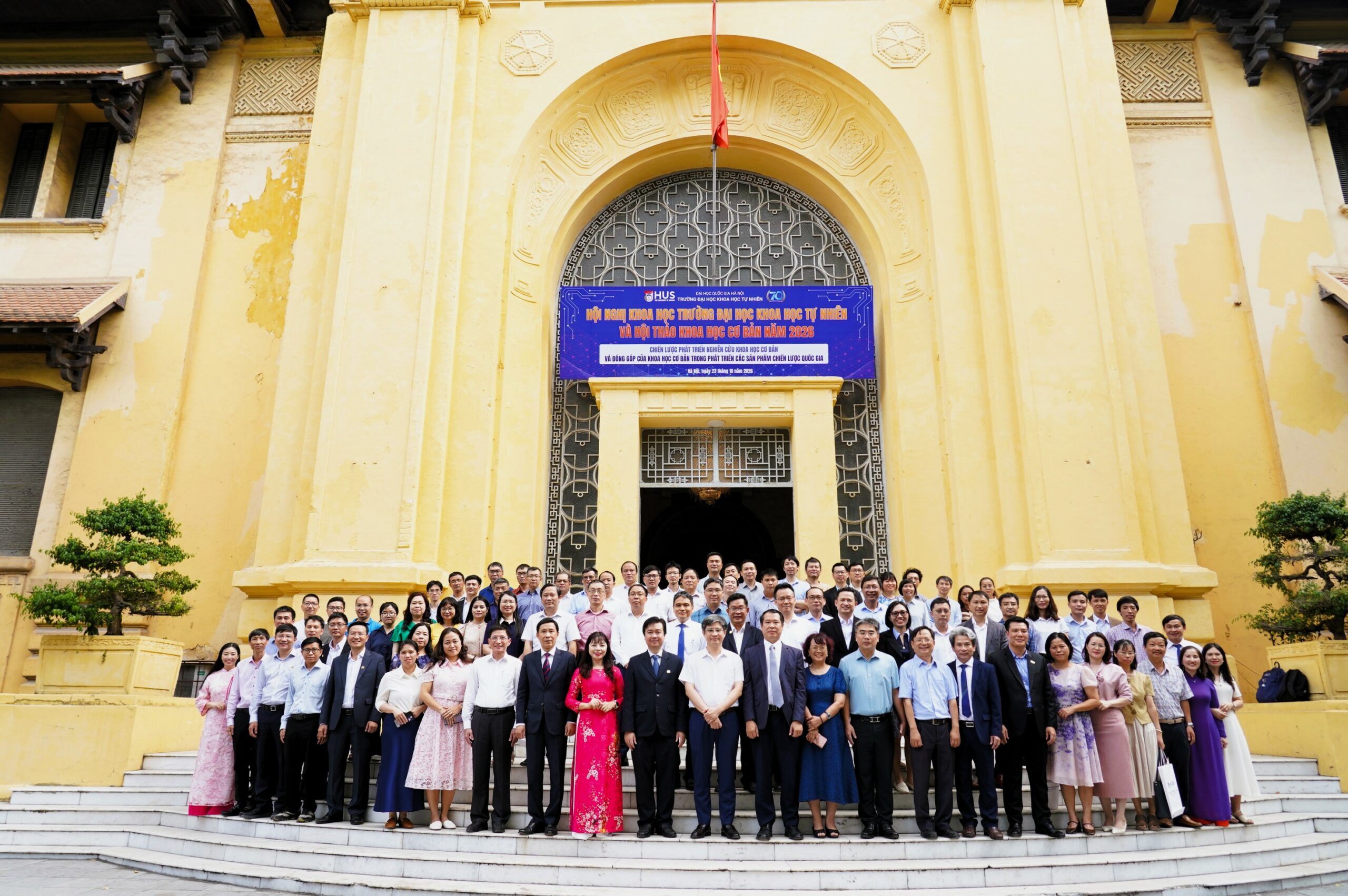
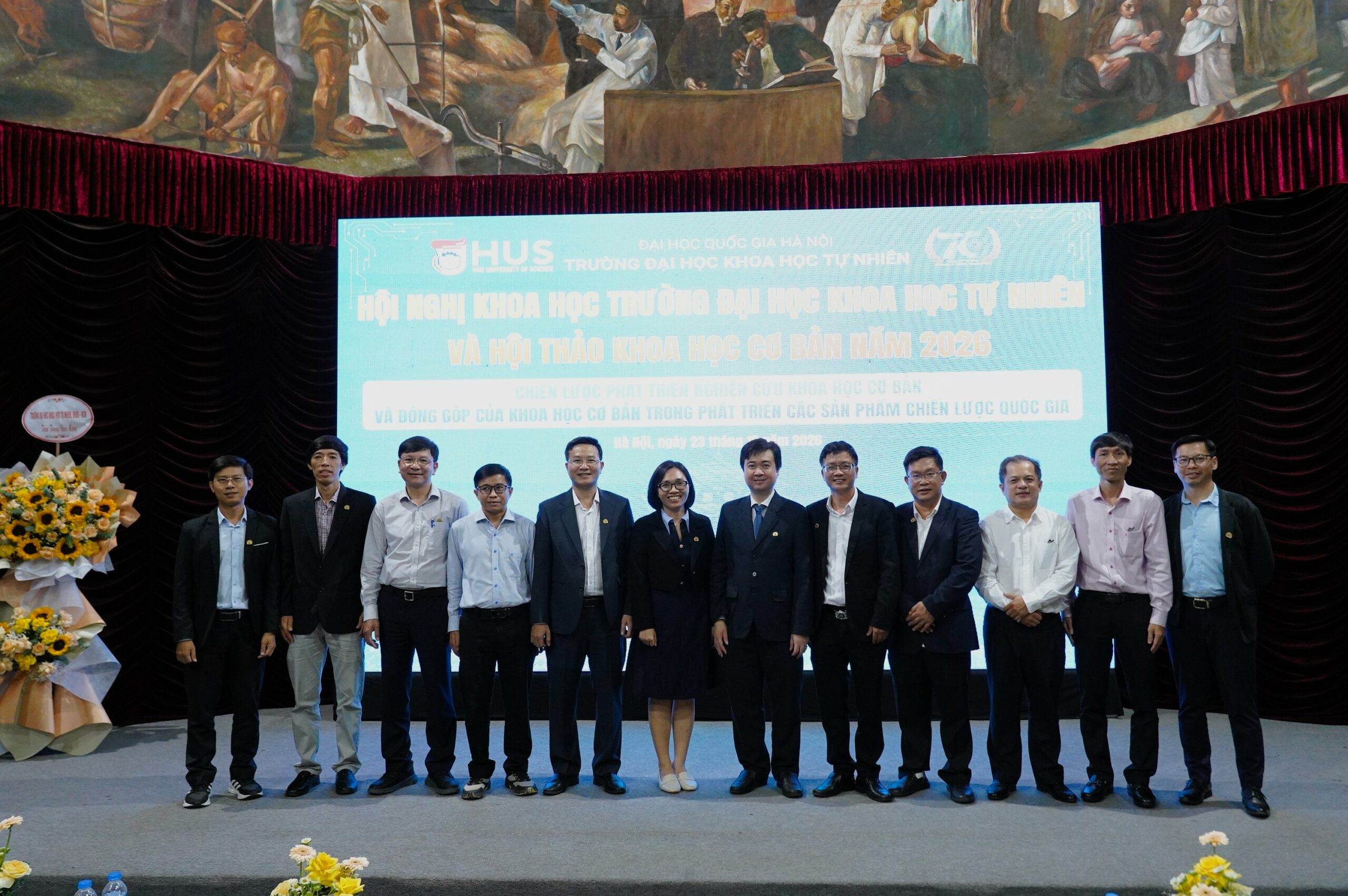
On 23 October, a delegation from VNUHCM–University of Science (HCMUS), led by Vice President Assoc. Prof. Trần Minh Triết, attended the Scientific Conference of VNU University of Science and the 2026 Conference on Fundamental Sciences. At the conference, HCMUS researchers presented a proposed model integrating fundamental research with strategic technologies, with the aim of translating scientific knowledge into products that support national technological self-reliance. The conference was held under the theme ‘Strategies for the Development of Fundamental Science Research and the Contribution of Fundamental Sciences to the Development of National Strategic Products’.
In the opening address, Prof. Lê Thanh Sơn, President of VNU University of Science, emphasised the role of fundamental sciences in Viet Nam’s development strategy towards 2045, particularly in the context of implementing Resolution No. 57-NQ/TW on breakthroughs in science and technology development, innovation and national digital transformation.
Accordingly, the development of fundamental sciences must go hand in hand with improvements to institutional frameworks and policies, the provision of financial resources, the training of highly skilled professionals and stronger international cooperation. Greater collaboration among universities, businesses and government agencies is also essential to improving technology transfer and translating research findings into practical applications.
At the conference, representatives of HCMUS presented a paper entitled ‘Developing a Model for Fundamental Research Integrated with Strategic Technologies: Insights from VNUHCM–University of Science’. The paper examined the role of fundamental research in establishing a knowledge base, advancing core technologies and developing strategic technology products. It also proposed a collaborative model to strengthen the translation of research outcomes into practical value.
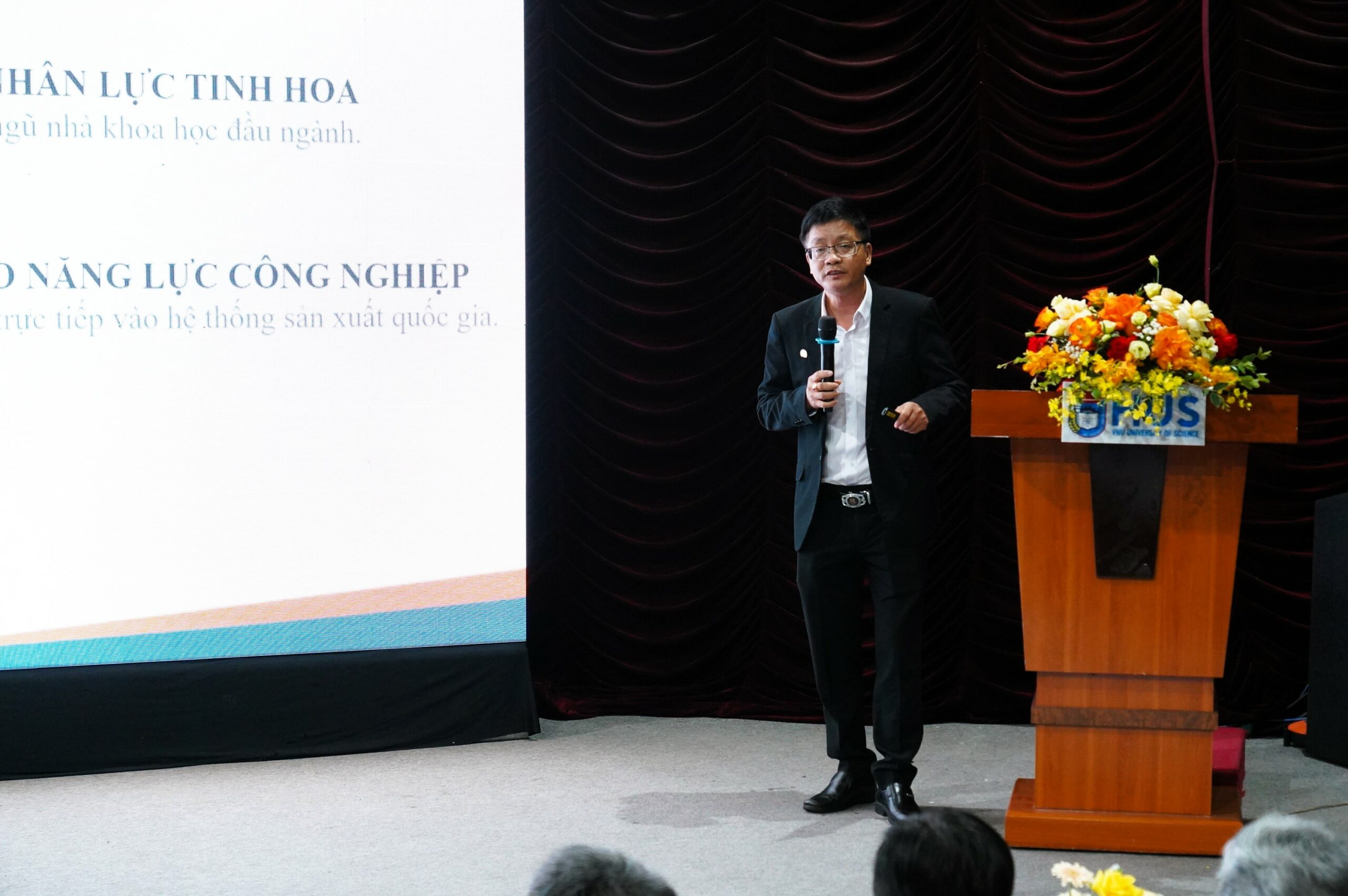
According to the authors, fundamental research not only generates new knowledge but also plays a strategic role in strengthening national technological self-reliance. Fields such as mathematics, physics, chemistry, life sciences, Earth sciences and environmental sciences provide scientific foundations for a wide range of priority technologies, from artificial intelligence, big data and semiconductor chips to biotechnology, advanced materials, renewable energy and energy storage. The development of fundamental sciences must therefore be considered in conjunction with long-term technological development and productive capacity.
Drawing on experience at HCMUS, the paper identified several barriers to translating research findings into products, including the gap between research and application, limited resources for product development, market risks, insufficiently close engagement with businesses, and obstacles relating to financial mechanisms and intellectual property. These constraints may leave research outcomes at the publication stage, preventing their full potential from being realised in manufacturing and industrial development.
To address these challenges, the authors proposed a four-phase collaboration model: input initiation; core research development; establishment of knowledge and technology transfer mechanisms; and output generation. Under this model, the State would provide strategic direction and ensure long-term investment; higher education institutions would strengthen research capabilities and train highly skilled professionals; intermediary organisations would support technology assessment, refinement and commercialisation; and businesses would connect research with market needs, adopt technologies and bring products into practical use. This approach seeks to establish an integrated pathway from scientific knowledge to technology development and national strategic products.
In terms of implementation, HCMUS aims to combine talent development, the advancement of leading research groups and centres of research excellence with the promotion of research in strategic technology fields. The paper highlighted priority areas including digital technology and artificial intelligence, biotechnology and biomedicine, semiconductors, and energy materials. The University also seeks to strengthen collaboration with businesses, develop intermediary research and technology organisations, and establish shared data infrastructure to support interdisciplinary research, resource integration and knowledge transfer.
Another notable proposal concerned reforming the governance of scientific research to place greater emphasis on quality, impact and the transferability of research outcomes, rather than focusing solely on publication numbers. This should be accompanied by ex-post evaluation mechanisms based on outcomes, a clear distinction between risks inherent in scientific experimentation and misconduct, and more effective governance of data and intellectual property assets.
Through the proposed model, the authors underscored the need to develop an ecosystem for fundamental research that effectively connects the State, universities, intermediary organisations and businesses. This approach is intended to unlock the value of foundational knowledge, advance core technologies, strengthen competitiveness and progressively realise Viet Nam’s ambition of achieving technological self-reliance in strategic technology fields by 2045.
Leave a Reply