


VNUHCM–University of Science (HCMUS) has been granted registration certificates by the Intellectual Property Office of Viet Nam, under the Ministry of Science and Technology, for two semiconductor integrated circuit layout designs. This achievement recognises the research and design capabilities in analogue and mixed-signal integrated circuits demonstrated by the author cohort at the Faculty of Electronics and Telecommunications.
The design titled “An 8-bit Flash Analogue-to-Digital Converter (ADC) signal conversion circuit utilising a Double-Tail comparator” received its Certificate of Registration under Decision No. 228/QĐ-SHTT dated 3 June 2026, remaining valid until 9 December 2032. The research team comprises Associate Professor Lê Đức Hùng, Master of Science Thái Hồng Hải, and Nguyễn Thị Thanh Xuân.
This layout design features an analogue-to-digital signal conversion function based on an 8-bit Flash ADC architecture fabricated using CMOS technology. The circuit can select eight analogue inputs via an analogue multiplexer, delivers an 8-bit binary output, and interfaces with microcontrollers through the Serial Peripheral Interface (SPI) standard.
According to the research team, the design aims to optimise component placement, minimise circuit resources, reduce physical area, and lower power consumption.
These parameters represent critical requirements for integrated circuit blocks, particularly within systems demanding high-speed data acquisition, low energy consumption, and compatibility with compact devices.

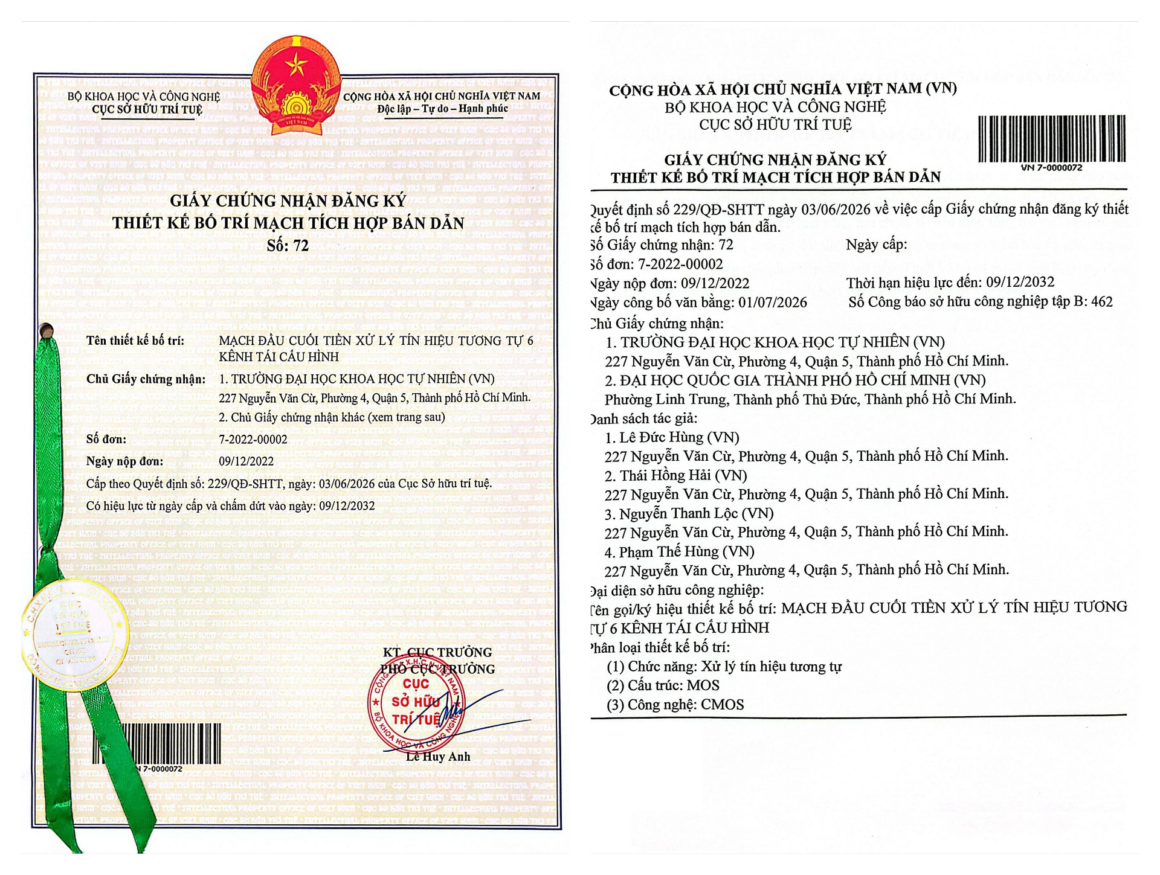
The design titled “A reconfigurable 6-channel analogue signal preprocessing terminal circuit” was granted its Certificate of Registration under Decision No. 229/QĐ-SHTT dated 3 June 2026, remaining valid until 9 December 2032. The author cohort includes Associate Professor Lê Đức Hùng, Master of Science Thái Hồng Hải, Nguyễn Thanh Lộc, and Phạm Thế Hùng.
The design focuses on analogue signal preprocessing functions, specifically tailored for biomedical applications and sensor signal acquisition systems. Comprising six analogue input channels implemented on CMOS technology, the configuration allows for the selection and reconfiguration of input impedance alongside amplification gain, whilst providing 8-bit analogue-to-digital conversion and communicating with microcontrollers via the serial SPI standard.
A semiconductor integrated circuit layout design qualifies for protection upon satisfying two core criteria: originality and commercial novelty.
Originality dictates that the layout must be the creative result of the authors themselves, and must not be widely known within the layout design community or amongst semiconductor integrated circuit manufacturers at the time of creation.
Furthermore, a design maintains commercial novelty only if the layout has not been commercially exploited anywhere in the world prior to the filing date of the protection application.
The research group notes that completing a single design requires approximately six to nine months, spanning stages from specification analysis, schematic drawing, and simulation evaluation, to layout design, post-layout evaluation, and design verification. These outcomes pave the way for integrating ADC conversion circuits and analogue signal preprocessing terminal circuits into microcontroller chips designed for data acquisition, sensor interfacing, Internet of Things (IoT) systems, and biomedical applications.
For HCMUS, the protection of these designs serves to confirm the training and research capacity in microchip design possessed by the academic staff, scientists, and students. The milestone contributes significantly to mastering analogue and mixed-signal microchip design specifically, as well as integrated circuit design more broadly.
Currently, HCMUS offers academic programmes in Microchip Design and Semiconductor Technology at undergraduate, master’s, and doctoral levels. Microchip design research activities are deployed across multiple streams, including signal acquisition and processing chips, RISC-V CPU chips, lightweight cryptography cores, post-quantum cryptography cores, artificial Intelligence (AI) chip systems featuring spiking neural networks, and AI-IoT chips for biomedical applications
Against a backdrop where microchips and semiconductors are identified as strategic technological sectors, the development and protection of semiconductor integrated circuit layout designs carry practical significance for training, research, and the cultivation of domestic chip design capabilities. From these certified designs, the research team can continue to refine, optimise, and integrate circuit blocks into larger application systems, thereby contributing to the development of the semiconductor microchip ecosystem at VNU-HCM and across Viet Nam.
Leave a Reply