

![[DOCTORAL THESIS DEFENCE] DOCTORAL RESEARCHER NGUYỄN MINH THẢO SUCCESSFULLY DEFENDS DOCTORAL DISSERTATION IN THEORETICAL AND PHYSICAL CHEMISTRY](https://en.hcmus.edu.vn/wp-content/uploads/2025/11/CAT_4061-scaled.jpg "CAT_4061")
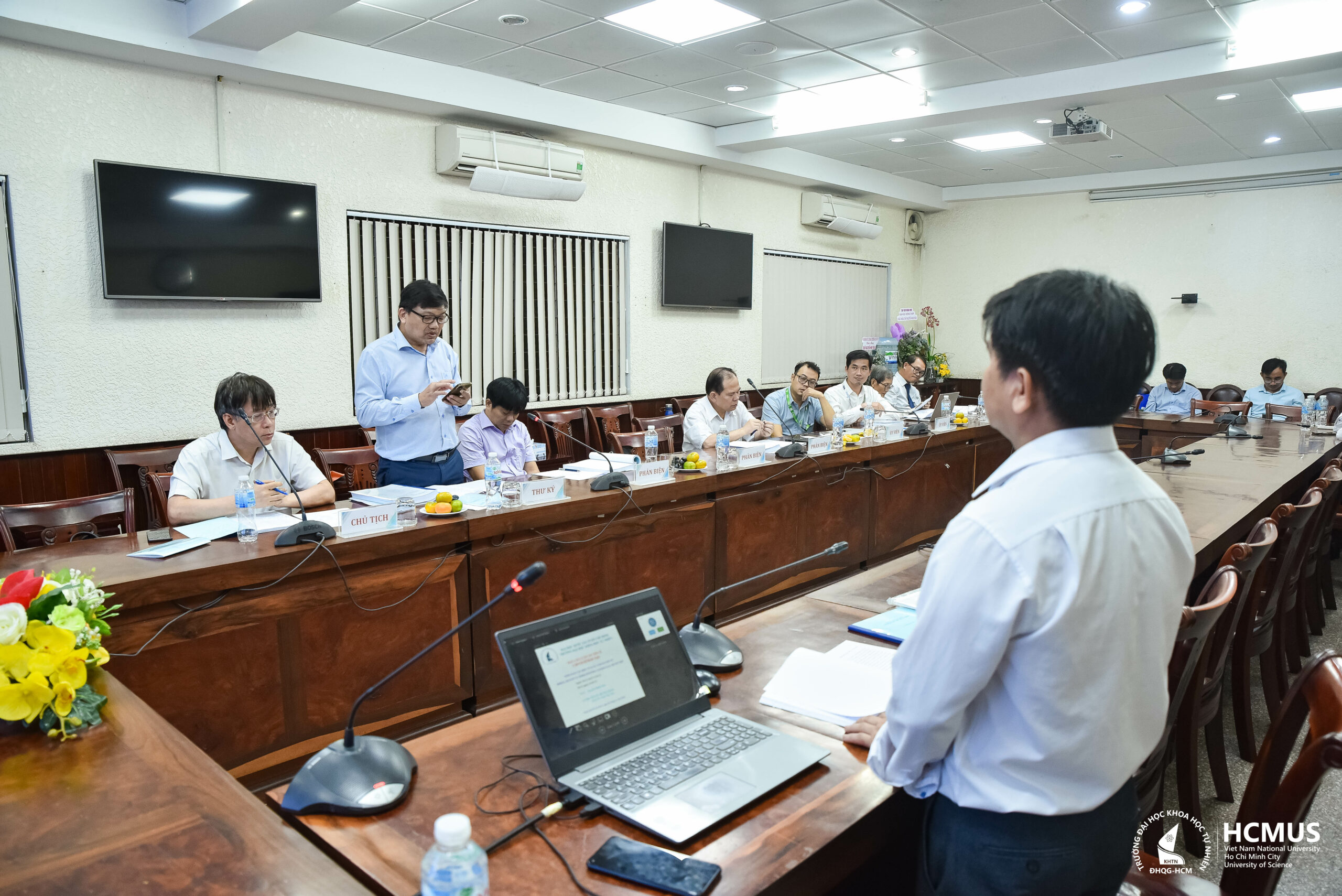
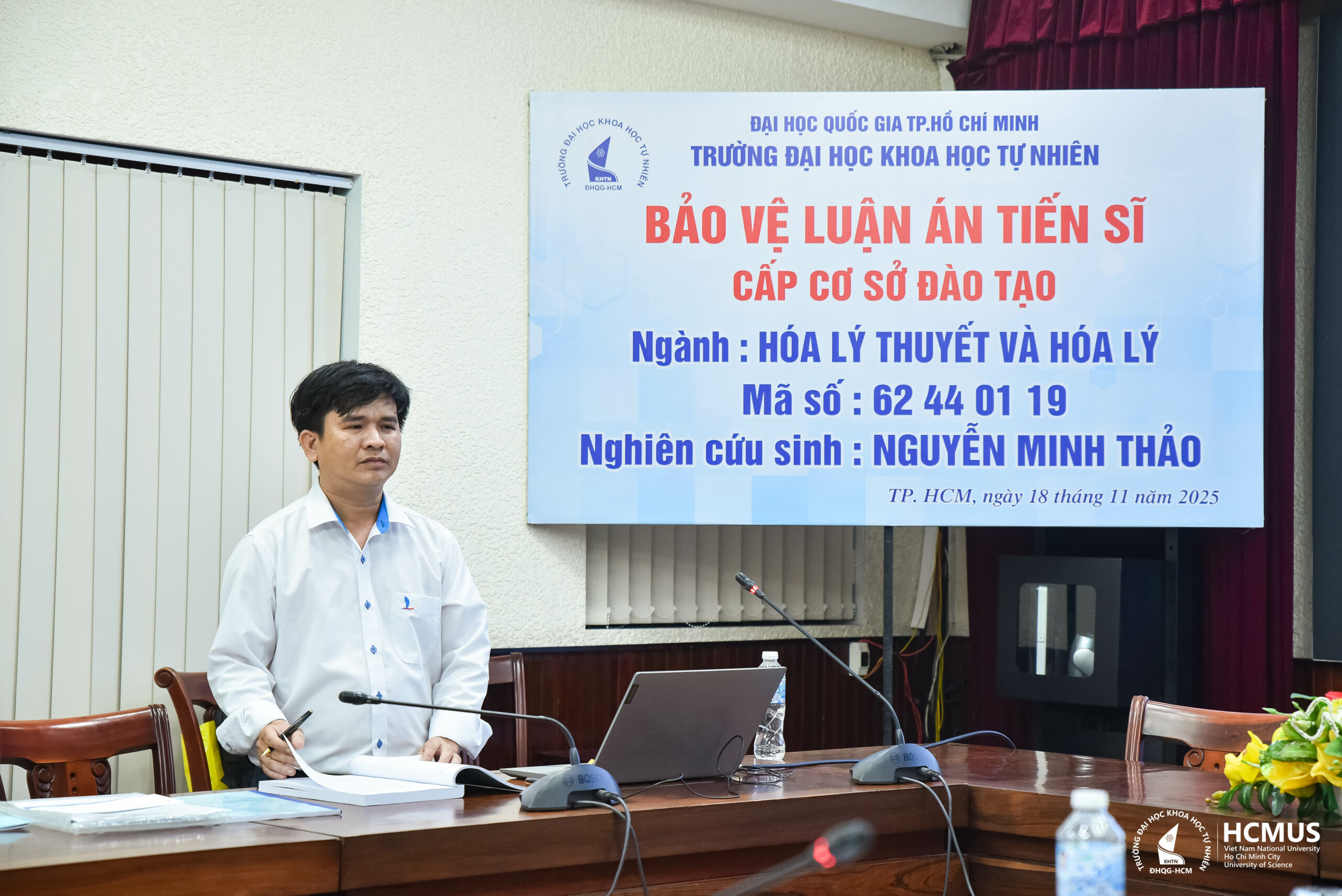
On 18 November, at VNUHCM-University of Science, doctoral researcher Nguyễn Minh Thảo successfully and excellently defended his doctoral dissertation in the specialisation of Theoretical and Physical Chemistry. The research, titled ‘Calculating the Structure of Transition Metal-Doped Boron, Silicon, and Germanium Atomic Clusters,’ was supervised by Assoc. Prof. Bùi Thọ Thanh and Assoc. Prof. Trần Văn Tân. The work offers a fresh and profound perspective on nanoscale materials, opening potential applications in semiconductor technology and environmental remediation.
Within modern materials science, atomic clusters of boron, silicon, and germanium serve as foundational ‘bricks’ for semiconductor technology. When doped with transition metals (such as Scandium, Vanadium, and Manganese), these clusters’ properties undergo dramatic changes, holding promise for the creation of superior materials for adsorption and catalysis.
However, researching these systems encounters a major physical barrier: the complexity of electrons within the transition metal’s ɗ orbitals creates a myriad of structures with nearly equivalent energy levels (energy degeneracy). This makes precise determination of the most stable structure a significant challenge for traditional experimental methods.
To overcome this difficult problem, doctoral researcher Nguyễn Minh Thảo employed an advanced approach: combining the power of Quantum Chemistry and Computer Science. Instead of manual searching, the author utilised intelligent search algorithms, such as the Genetic Algorithm and Particle Swarm Optimization, to fully scan the potential energy surface. Subsequently, high-precision chemical calculation methods like DFT, CCSD(T), and notably the multi-configuration method CASSCF/CASPT2 were applied to confirm the structures and energy properties with the highest reliability.
The most valuable aspect of the dissertation resides in the specific findings, which directly enrich the international materials data repository. Through the calculation process, the geometric and electronic structures of the metal-doped boron, silicon, and germanium atomic clusters were successfully determined. Remarkably, the research announced new stable structures (such as Sc₂B₈ and the ScGe₆⁻ ion) which exhibit significantly higher stability compared to structures previously reported by other research groups. This provides clear evidence of the effectiveness of the structure-searching method applied.
The dissertation extended beyond static structure, delving into the prediction of spectroscopic properties—a critical tool for experimental comparison. Using complex multi-configuration calculations, the author accurately predicted the electron detachment processes of the VSi₂⁻ cluster. This data provides a ‘map,’ allowing experimentalists to precisely identify the locations of peaks on the photoelectron spectrum, thereby simplifying material identification.
A further significant contribution of the dissertation concerns the ability to guide applications in exhaust gas treatment and catalysis. The author successfully built interaction models between the studied atomic clusters and small gas molecules such as H₂, CO, and CO₂. The simulation results revealed an interesting rule: the adsorption sites (positions where the gas adheres most strongly) tend to cluster around the doped transition metal element. This finding forms an important theoretical basis for materials scientists designing high-efficiency gas filters, fuel cells, or catalysts in the future.
The dissertation not only resolves complex theoretical issues but also lays a solid foundation for the development of new materials. The stable structures discovered will serve as a basis for expanding research to larger-sized material systems.
Leave a Reply