

![[OUTSTANDING ROLE MODELS] PROFESSOR NGÔ ĐẠI NGHIỆP: THE JOURNEY OF VALORISING WASTE INTO KNOWLEDGE](https://en.hcmus.edu.vn/wp-content/uploads/2026/02/605734670_1282412673919859_9016364352032980453_n.jpg "605734670_1282412673919859_9016364352032980453_n")
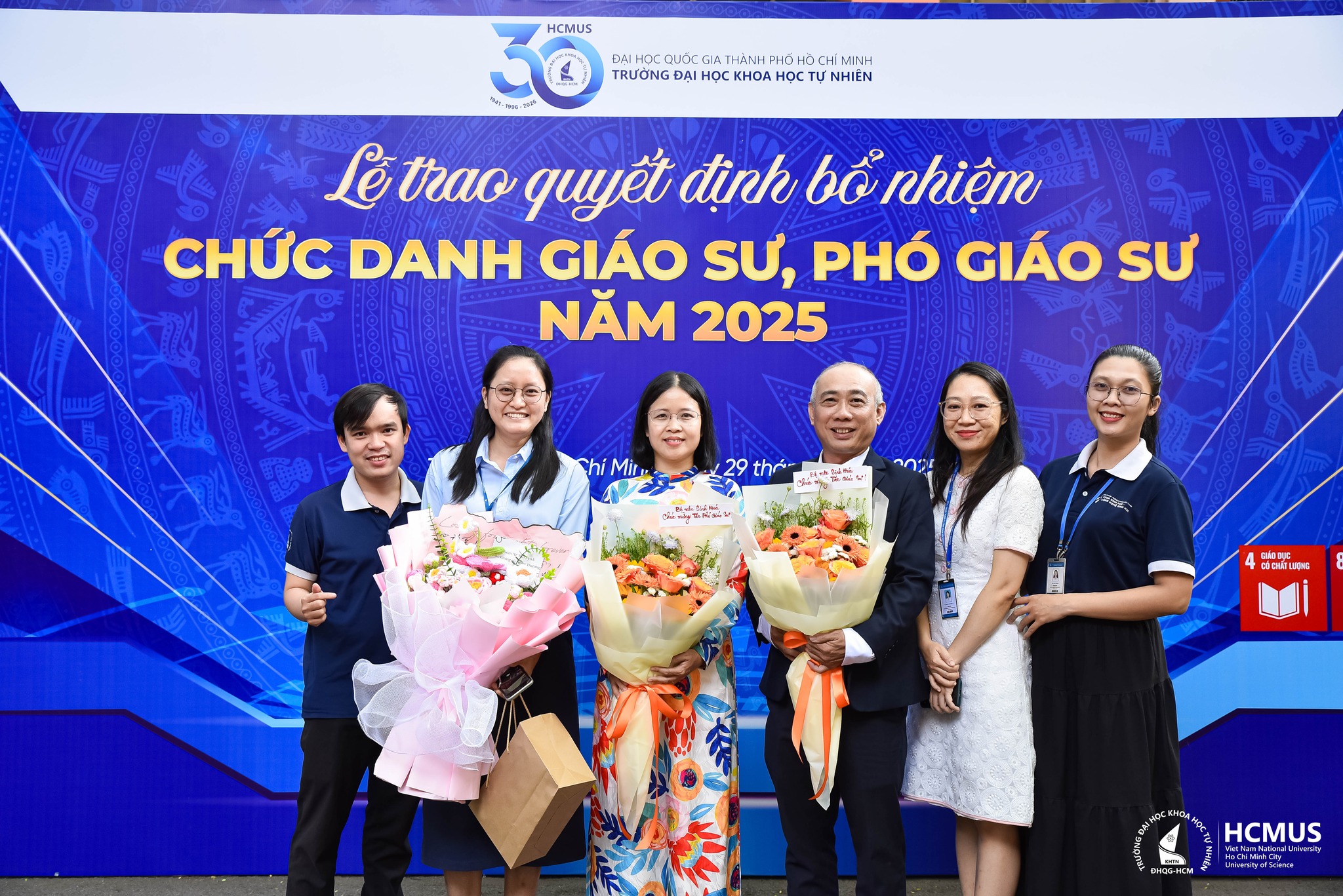
Professor Ngô Đại Nghiệp receiving his official appointment at the ceremony.
In 2025, alongside the nation’s pre-eminent scientists, Professor Ngô Đại Nghiệp of the Department of Biochemistry, Faculty of Biology and Biotechnology at VNUHCM-University of Science (HCMUS), was officially conferred the title of Professor of Biology by the State Council for Professorship. At the age of 50, following nearly three decades of dedication to research and pedagogy, Professor Nghiệp is distinguished not only by his high-impact applied research but also by the resilient and unassuming passion of a scholar who views science as a ‘natural vocation.’
A Vocation for Applied Science
Born in 1975 and raised in the Mekong Delta during a period when career guidance and technical information were scarce, the young Ngô Đại Nghiệp initially chose Biology out of a fascination with the field’s diversity. He harboured a dream of entering medicine to heal others—a legacy inspired by his great-grandfather, a practitioner of traditional medicine. This serendipitous choice evolved into a lifelong commitment where science transcended the classroom to become a life’s work.
Professor Nghiệp recalls that his true entry into the world of Biochemistry—the cornerstone of modern biotechnology—occurred upon his admission to the University of Ho Chi Minh City (the predecessor of HCMUS). It was here that he realised Biology extended far beyond theory; it offered tangible solutions for agriculture, food security, medicine, and the environment. Most significantly, it held the potential to transform waste products into vital resources.
“The defining moment of my career arrived in 1998, when the faculty at the Department of Biochemistry invited me to remain as a teaching assistant,” Professor Nghiệp reflects. This brief enquiry established a lifelong trajectory: a deep immersion into the world of enzymes, biochemistry, and bioactive compounds derived from flora, fauna, and the waste products of industrial food processing.
Professor Nghiệp’s early research was defined by a remarkable blend of physical resilience and hands-on scientific enquiry. His 1998 graduation thesis was a profoundly ‘real-world’ journey; while culturing bacteria to extract protease, he spent his early mornings cycling from Tan Binh to Hoc Mon before dawn to manually harvest fresh papaya resin directly from the trees to obtain papain. “It was exhausting but joyful,” he recalls, noting that the reward of a successful laboratory result made every hardship worthwhile.
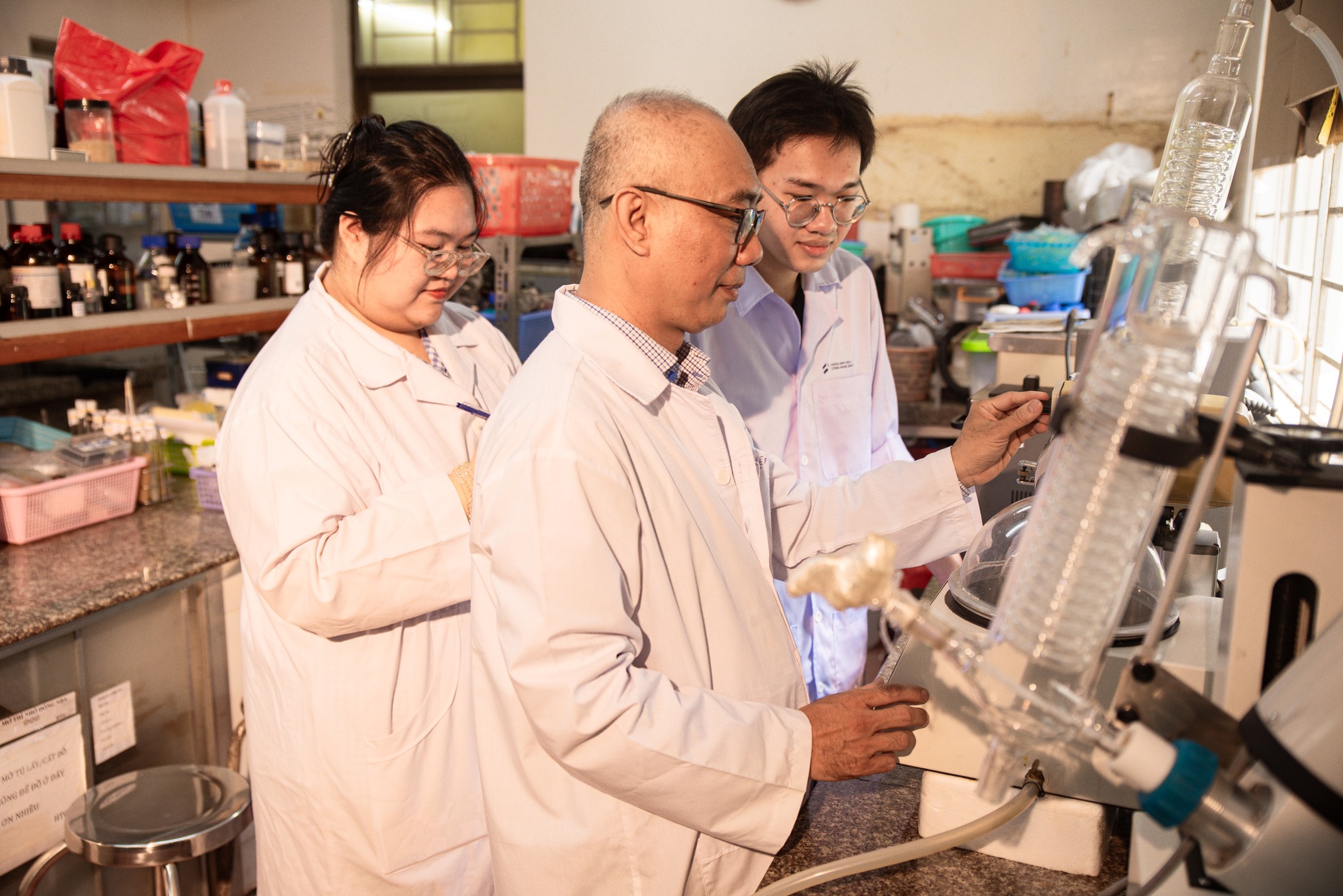
This dedication continued into his Master’s thesis, where he focused on ficin from fig trees. He encountered significant challenges with local raw materials, discovering that Vietnamese fig latex oxidises much more rapidly than international varieties, which severely complicates enzyme separation. This required him to personally climb trees to collect samples—a process that provided vital insights into the biochemical differences between native and foreign flora. These experiences taught him the necessity of adapting global scientific protocols to the specific characteristics of the Vietnamese environment.
A pivotal transition occurred during his doctoral research in South Korea, where he specialised in chitosan and its derivatives. Initially overwhelmed by sophisticated machinery and unfamiliar chemical methodologies, he adopted a rigorous self-study regime to bridge the gap. By maintaining a humble approach and seeking knowledge ‘at every opportunity,’ he overcame a period he describes as ‘seemingly insurmountable.’
Between 2004 and 2011, amidst a scarcity of equipment and funding in Viet Nam, Professor Nghiệp pioneered a flexible approach to research. He focused on waste products—such as brewery waste, cassava pulp, and soybean husks—aligning his research with industrial needs to secure socialised investment. By designing experiments based on domestic techniques, he achieved high-quality, cost-effective results. Furthermore, collaborations with colleagues both within and outside the university, alongside research projects funded by HCMUS, VNUHCM, the Department of Science and Technology of Ho Chi Minh City, and the Young Science and Technology Incubator Programme, provided him with enhanced equipment, technical knowledge, and fresh research perspectives.
The most enduring aspects of his career are the ‘authentic human moments’: the sleepless nights in the laboratory, the recurring failures, and the vital encouragement from colleagues and family. These research strands culminated in significant innovations, most notably ‘Instant Bird’s Nest,’ a commercial success that allowed for the reinvestment into laboratory facilities and demonstrated the seamless transition from fundamental science to industrial application.
The Professorship and the Duty of Mentorship
Upon the announcement of his professorship in 2025, Professor Nghiệp experienced a profound sense of gratitude. “I only wish my parents were here to witness this moment,” he shared. For him, the title clarifies his responsibility: to mentor the next generation with a rigorous scientific mindset and a spirit of service. He maintains that a university academic must not only lecture but also instil the conviction that students can succeed through persistence.
“Knowledge evolves, but it is one’s attitude and spirit that sustain a career. I remain deeply moved by my former students, particularly the group affectionately known as ‘The Zoo’ for their diligence and solidarity. They remind me that the true value of teaching lies in the individuals it shapes,” Professor Nghiệp remarked.
In the laboratory, his ‘iron discipline’ demands absolute precision. He asserts that even under resource-constrained conditions, data integrity must remain beyond reproach. He believes that while a talented scientist produces results, it is the resilient scientist who maintains that excellence over decades. For him, the most critical attribute for young Vietnamese researchers is perseverance.
If his scientific philosophy could be distilled into two pillars, they would be: “Passion and Persistence.” His message to aspiring researchers is simple: “Failure is the mother of success. Do not despair when outcomes do not meet expectations.”
The 2025 professorship is more than a recognition of his scholarly output; it is a milestone in a journey of professional rigour and the warmth of a teacher who rekindles the fire in his students. Professor Nghiệp extends his sincere gratitude to the supporting institutions, including VNUHCM, HCMUS, the Department of Science and Technology of Ho Chi Minh City, the Centre for Young Science and Technology Development (under the Ho Chi Minh City Communist Youth Union) through its Young Science and Technology Incubator Programme, the National Foundation for Science and Technology Development (NAFOSTED), and his various industrial partners.
Leave a Reply