

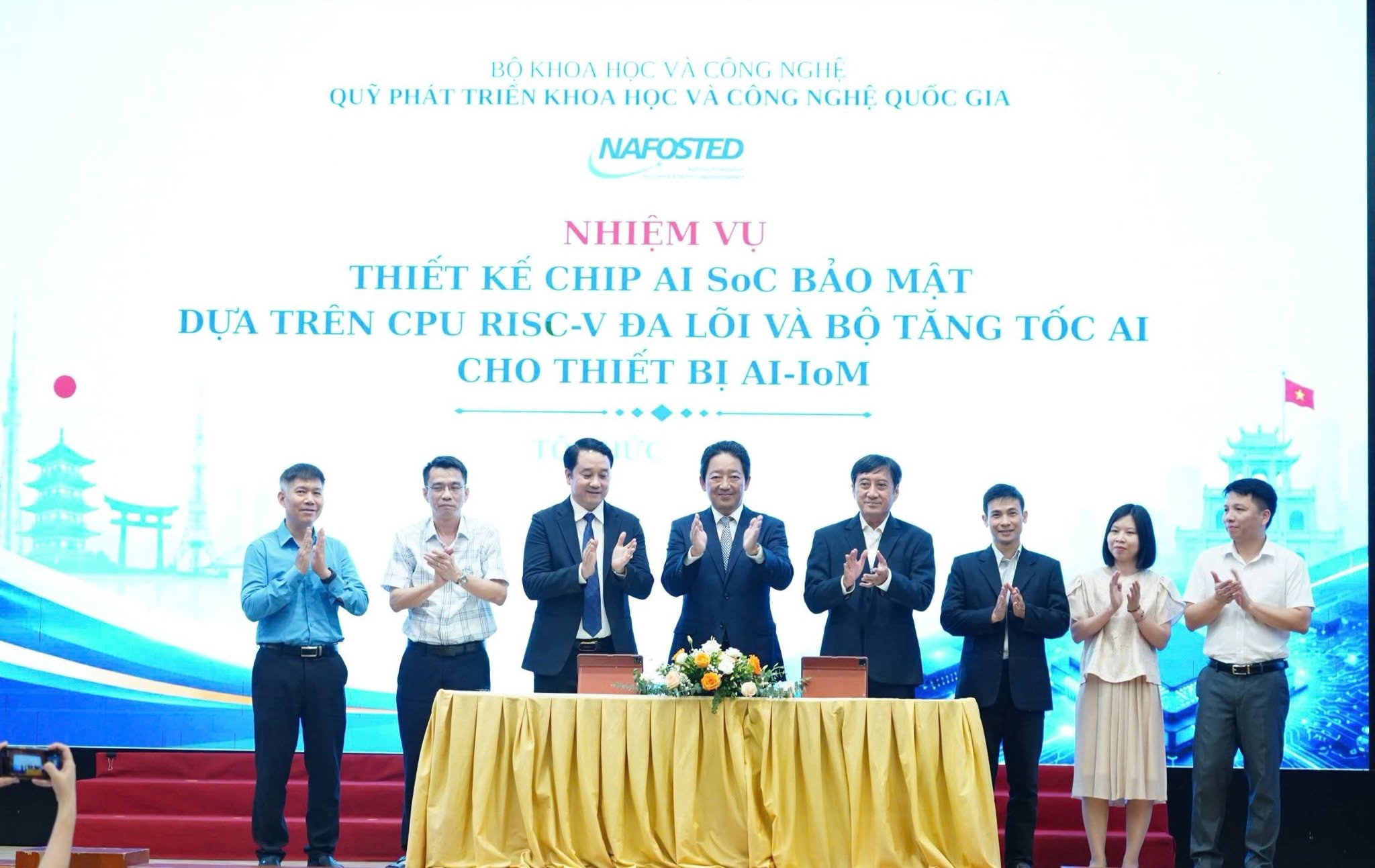
On 22 July, in Ha Noi, the National Foundation for Science and Technology Development (NAFOSTED), under the Ministry of Science and Technology, announced the selected projects and held a contract-signing ceremony for five Viet Nam–Japan collaborative semiconductor research projects funded in 2026. HCMUS will lead one of the five projects selected for funding.
The project, entitled “Secure AI SoC chip design based on a multi-core RISC-V CPU and AI accelerator for AI-IoMT devices“, will be undertaken by the research team from the Faculty of Electronics and Telecommunications at HCMUS in collaboration with the University of Electro-Communications (UEC), Japan.
The project will be jointly led by Assoc. Prof. Lê Đức Hùng of HCMUS, representing the Vietnamese team, and Prof. Phạm Công Kha of the University of Electro-Communications, representing the Japanese team.
The primary objective is to jointly develop a secure system-on-chip architecture based on a multi-core RISC-V CPU integrated with an AI accelerator for Artificial Intelligence–Internet of Medical Things (AI-IoMT) applications. Expected outcomes include the development of AI chip intellectual property (IP) cores for biomedical applications and a non-invasive blood glucose sensing IP core. Prototype fabrication will be carried out in Japan through collaboration between both partners.
Alongside research and product development, the project aims to develop expertise in semiconductor chip and system-on-chip design under the “Make in Vietnam” initiative, train highly skilled semiconductor researchers and engineers in both Viet Nam and Japan, and create pathways towards the commercialisation of semiconductor technologies.
The project will strengthen Viet Nam’s research capability, scientific and technological self-reliance, and innovation capacity while expanding academic exchange and research collaboration between Vietnamese and Japanese scientists in semiconductor integrated circuits.
Selection for funding reflects the international research capability and semiconductor design expertise of researchers at HCMUS, contributing to national efforts to strengthen technological capability and advance Viet Nam’s semiconductor ecosystem.
Viet Nam–Japan Collaborative Semiconductor Research Programme
In 2026, the Viet Nam–Japan Collaborative Semiconductor Research Programme approved funding for five research projects:
- Secure AI SoC chip design based on a multi-core RISC-V CPU and AI accelerator for AI-IoMT devices.
- Research and development of wide-bandgap semiconductor materials and power electronic devices for power management chips used in high-performance power systems.
- Research and development of advanced semiconductor materials for integrated sensors and renewable energy devices.
- Development of advanced semiconductor materials for high-electron-mobility transistors through integrated theoretical simulation and experimental research.
- Design, simulation and fabrication of next-generation three-dimensional CFET integrated circuits using silicon thin-film transistors.
Leave a Reply