

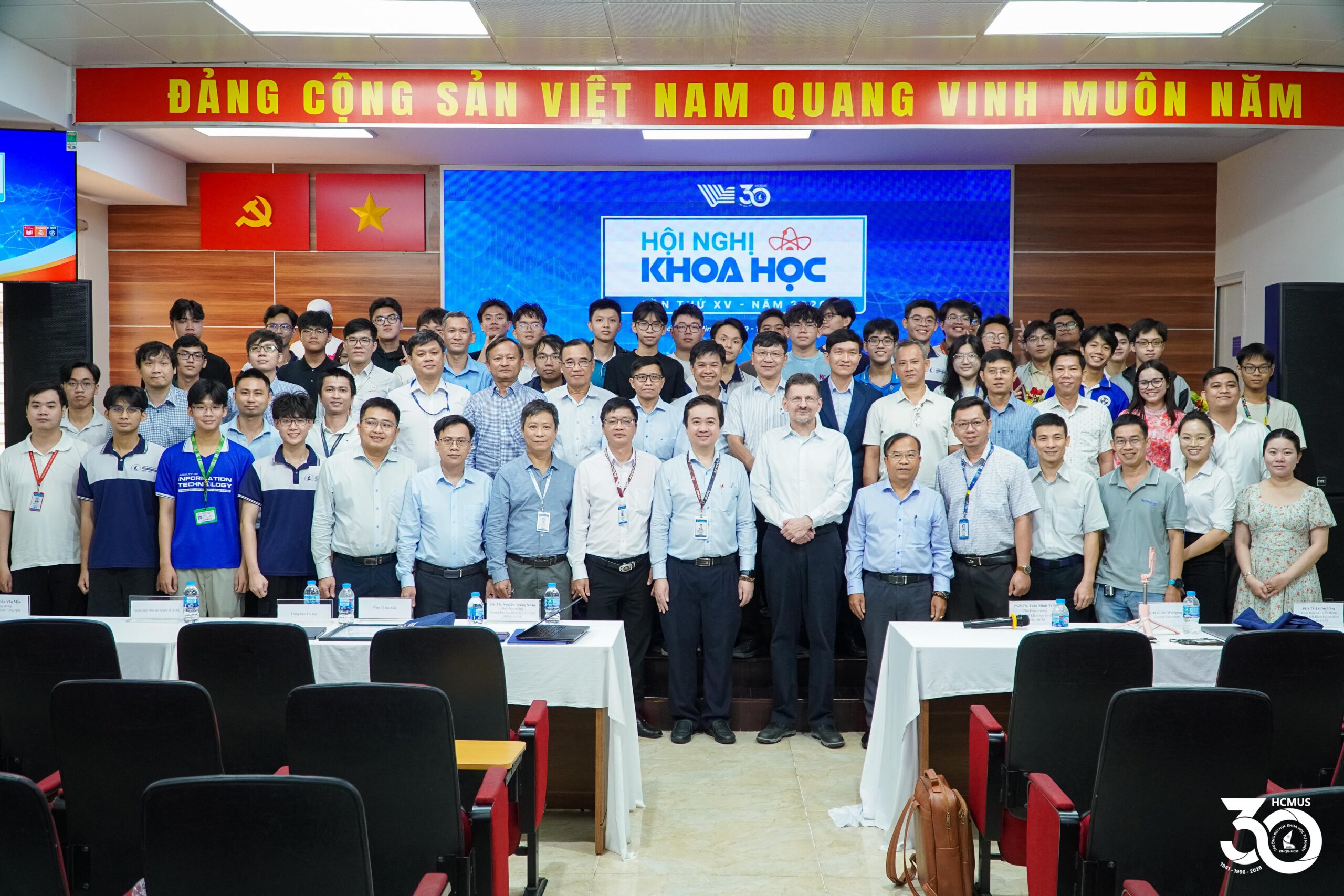
With 11 international conferences, four national scientific workshops, 1,963 scientific papers and 3,336 delegate attendances, the 15th Scientific Conference of VNUHCM–University of Science in 2026 marked the largest edition to date. The series of events not only broadened international academic connections but also provided a platform for in-depth exchange across a wide range of scientific and technological disciplines.
On 09 November, VNUHCM–University of Science held the opening ceremony and plenary session of the 15th Scientific Conference 2026. The event formed the centrepiece of a series of scientific conferences and workshops taking place from August to December 2026, bringing together scientists, experts, doctoral researchers, postgraduate candidates and undergraduates from Viet Nam and overseas.
The largest edition to date, strengthening international academic connections
In his opening remarks, Assoc. Prof. Trần Minh Triết, Vice President of VNUHCM–University of Science, noted that the 15th Scientific Conference 2026 held particular significance as the University marked its 30th anniversary of joining VNUHCM. Over 15 editions, held biennially, the conference has gradually evolved from a domestic academic exchange forum into a series of events involving the international scientific community. Before 2022, each edition featured approximately 500–600 papers. In 2024, the University hosted six international conferences and seven national workshops, with a total of 828 papers.
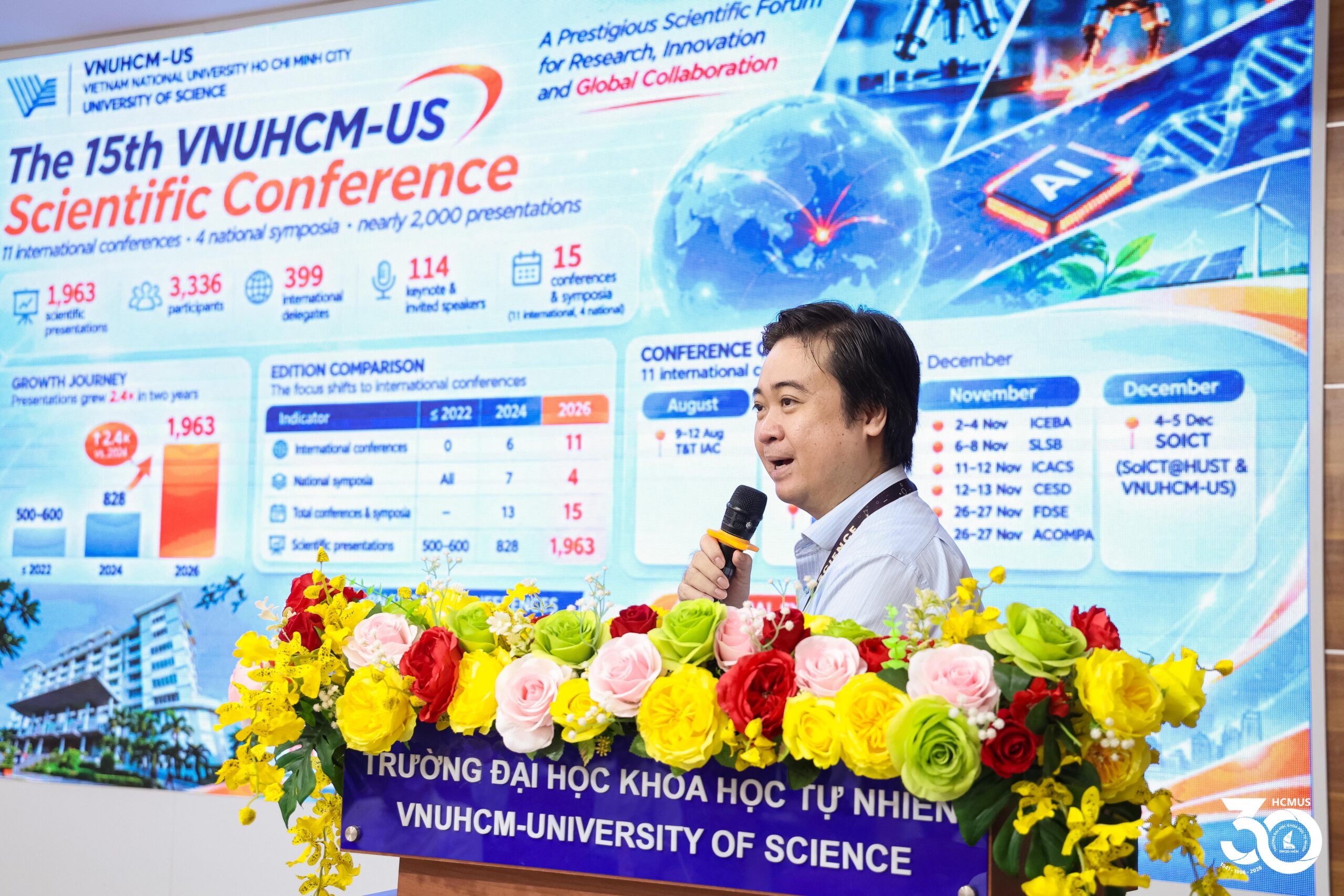
“The scale of this year’s conference reflects the proactive efforts of academic staff across our faculties to expand academic activities and strengthen connections with the international scientific community. Notably, international conferences are increasingly organised through the University’s own academic expertise and research capacity, contributing to enhanced academic standing and broader research collaboration networks,” Assoc. Prof. Trần Minh Triết emphasised.
The 15th Scientific Conference 2026 comprised 15 events, featuring 1,963 scientific papers and 3,336 delegate attendances across 11 international conferences, including 399 international delegates and 114 keynote and invited speakers. Of the total number of papers, 1,613 were presented at international conferences, while the four national scientific workshops accounted for 350 papers. At the international conferences alone, 871 papers were delivered through oral presentations and 742 through poster presentations. Compared with 2024, the number of scientific papers increased approximately 2.4-fold, while the number of international conferences rose from six to 11. These figures reflect not only the growth in organisational scale but also the University’s capacity to strengthen academic connections, mobilise research resources and expand collaborative research activities.
11 international conferences spanning a wide range of specialised research fields
The 11 international conferences were held consecutively from August to December 2026, covering disciplines including physics, chemistry, materials science, life sciences, biotechnology, Earth sciences, electronics, information technology, computing and data security.
In August, the 12th International Aerosol Conference and Technical Meeting (T&T IAC 2026) took place from 09–12 August, featuring 95 scientific papers and 216 delegates from 10 countries. In October, three conferences followed: the 4th International Workshop on Nano Materials for Energy Storage and Conversion (NMEC-4 2026), with 51 papers, 180 delegates and 22 invited speakers; the 2nd International Conference on Advanced and Multifunctional Materials (ICAMM 2026), with 101 papers, 250 delegates and 22 invited speakers; and the International Conference on Sustainable Chemistry (ICSC 2026), with 207 papers, 500 delegates and 65 international participants from the United States, Taiwan, Japan, South Korea and Thailand.
In November, the 7th International Conference on Engineering, Physics, MEMS-Biosensors and Applications (ICEBA 2026) was held from 02–04 November, attracting 181 papers and 300 delegates. The conference adopted a hybrid format, with activities at VNUHCM–University of Science and in Vung Tau.
One of the highlights of the series was the inaugural International Conference on Sustainable Life Science and Biotechnology (SLSB 2026), held from 06–08 November. The conference recorded 340 scientific papers, 457 research abstracts and approximately 1,000 delegates. Participants represented 20 countries and territories and 93 educational and research institutions, with support from 24 sponsoring organisations, demonstrating the appeal of this academic forum in life sciences and biotechnology.
Other international conferences held in November included the International Conference on Advanced Circuits and Systems (ICACS 2026), on 11–12 November, with 34 papers, 100 delegates and four keynote speakers; and the Conference on Earth Sciences and Sustainable Development (CESD 2026), on 12–13 November, featuring 130 papers, with 40 papers selected for a special issue of a Scopus-indexed journal.
On 26–27 November, two conferences on data technologies and computing were scheduled to take place concurrently. The 13th International Conference on Future Data and Security Engineering (FDSE 2026) received 386 submissions, of which 101 were accepted, giving an acceptance rate of 26.2%. The 20th International Conference on Advanced Computing and Analysis (ACOMPA 2026) received 150 submissions, with 45 accepted, corresponding to an acceptance rate of 30%.
The series will conclude with the 15th International Conference on Information and Communications Technology (SOICT 2026), scheduled for 04–05 December, in collaboration with SOICT@HUST. The conference received 690 submissions, of which 328 were accepted, with scientists from 30 countries participating.
Four national workshops fostering interdisciplinary exchange
Alongside the international conferences, four national scientific workshops were organised as part of the 15th Scientific Conference, covering Mathematics and Computer Science; Educational Technology; Nuclear Engineering and Medical Physics; and Information and Communications Technology. The activities began on 09 November 2026, providing opportunities for professional exchange among scientists, lecturers, doctoral researchers and students.
The Mathematics and Computer Science subcommittee recorded the largest number of contributions, with 129 papers, including 109 oral presentations and 20 posters. The programme featured eight specialised subcommittees and one special session, running from 09–15 November. A highlight was the special session “30 Years of Inverse and Ill-posed Problems”, featuring 10 presentations and focusing on a specialised research direction in mathematics.
The Educational Technology subcommittee featured 81 papers, including five keynote presentations, 36 oral presentations and 40 posters. The Nuclear Engineering and Medical Physics subcommittee recorded 75 papers, comprising 20 oral presentations and 55 posters. Meanwhile, the Information and Communications Technology subcommittee featured 65 papers, including three keynote presentations and 62 scientific contributions.
In total, the four national scientific workshops featured 350 papers and eight keynote presentations. The organisation of specialised sessions across individual disciplines provided opportunities for scientists to publish research findings, exchange methodologies and strengthen connections among research groups.
With thousands of delegate attendances, nearly 2,000 scientific papers and a conference network spanning a wide range of disciplines, the 15th Scientific Conference of VNUHCM–University of Science 2026 further reinforces the University’s role as a major academic forum. Through these activities, the University contributes to knowledge exchange, strengthens domestic and international research collaboration, and creates further opportunities for scientific findings to be shared, critically reviewed and connected with the wider research community.
Leave a Reply