

![[OUTSTANDING ROLE MODELS] ASSOC. PROF. PHẠM KIM NGỌC: SWEET REWARDS FOR THOSE POSSESSING SUFFICIENT PASSION AND PERSISTENCE IN SCIENCE](https://en.hcmus.edu.vn/wp-content/uploads/2025/12/pgs.ts-pham-kim-ngoc1.jpg "pgs.ts-pham-kim-ngoc1")
With nearly two decades dedicated to materials science, Assoc. Prof. Phạm Kim Ngọc – Head of the Department of Nano Materials and Thin Films, Faculty of Materials Science and Technology, VNUHCM-University of Science – holds the firm belief that sweet rewards await those displaying sufficient passion and persistence on the research journey.
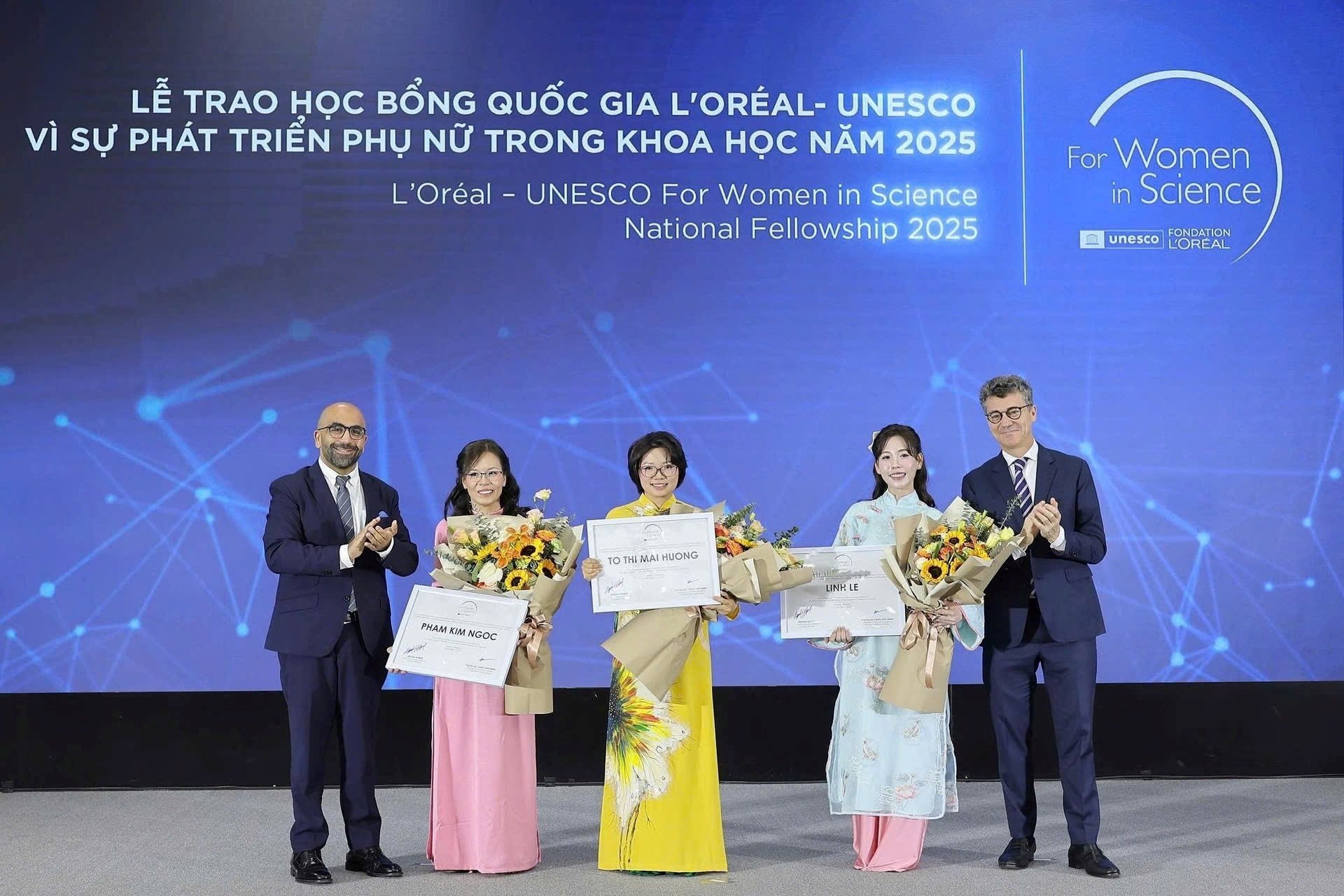
In 2025, Assoc. Prof. Phạm Kim Ngọc stands as one of three female Vietnamese scientists awarded the L’Oréal – UNESCO “For Women in Science” Scholarship for the proposal “Research and fabrication of memristor devices and circuits, utilised as artificial synapses in neuromorphic computing systems.”
A reporter from Popular Science Magazine spoke with Assoc. Prof. Phạm Kim Ngọc regarding the journey of nearly twenty years in science, the passion for nanomaterials, and the semiconductor research direction within the AI era.
Faith in the Chosen Path
What feelings does the selection as one of the three scientists receiving the L’Oréal – UNESCO scholarship, an award for the development of women in science, evoke?
A profound sense of honour and happiness arises upon receiving the news of the selection for this year’s L’Oréal – UNESCO scholarship. This achievement marks a journey of nearly twenty years pursuing the path of research into new materials alongside the collective of teachers, colleagues, and the students within the group.
The award represents not merely personal recognition but serves as a reminder of the responsibility lying ahead: to remain steadfast and continue transmitting motivation to young scientists, particularly female researchers.
What motivation led you to the field of materials science – a sector relatively nascent in Viet Nam at the time of commencement?
Upon commencing studies in the Faculty of Materials Science at the University of Science in 2002, the fascinating aspects of this field became apparent. Nanostructured materials possess novel characteristics and deliver superior efficiency across all areas of life. Among these, thin film materials in the form of coatings ranging from a few nanometres to micrometres in thickness have elevated the development of opto-electronic components and devices to a new height.
In 2009, the research group initiated the fabrication of thin film layers via Physical Vapour Deposition (PVD) techniques, applying these layers in data storage memory. The results produced by the group, published in prestigious international journals regarding materials science and physics, have affirmed the novelty and value of the research.
Although the semiconductor technology sector remains relatively new in Viet Nam, the foundation previously established by the group rendered the approach and development of semiconductor components quite favourable. Furthermore, alongside Resolution 57 and recent development policies regarding science and technology, new materials and semiconductors currently represent areas receiving significant attention and promotion. Such factors reinforce the belief that the direction chosen by the group proves entirely correct.
Step-by-Step Construction of Foundations for Neuromorphic Computing Systems
What is the rationale behind the decision to undertake the proposal “Research and fabrication of memristor devices and circuits, utilised as artificial synapses in neuromorphic computing systems,” the work awarded the L’Oréal – UNESCO Prize?
Currently, the explosive development of Artificial Intelligence (AI) necessitates immense computational capacity. However, the traditional computer architecture, known as the von-Neumann architecture, featuring separate processing and memory units, has begun to reveal limitations. Data constantly transferring back and forth between these two components creates the so-called “von-Neumann bottleneck.” This phenomenon causes the training and operation of AI models to consume excessive energy whilst failing to achieve the desired speed.
Our proposal approaches a more breakthrough direction: In-Memory Computing (IMC). In this architecture, processing occurs directly within the memory rather than requiring constant data movement, thereby saving energy and significantly increasing calculation speed.
The focus of the research lies on the memristor, an electronic device capable of storing multiple state levels similar to synapses in the human brain. The strength of the memristor involves small dimensions, the capability for continuous (analogue) state storage, low energy consumption, and ease of integration into large arrays to simulate neural networks.
The group concentrates on the Self-Rectifying Memristor (SRM), which aids in increasing reliability, limiting leakage current, and enhancing circuit performance. The research undergoes implementation from the materials level – involving selection, fabrication, and characterisation – to the component structure, and finally, integration into sample circuits.
The objective entails building the foundation for neuromorphic computing systems step by step; experts view such systems as the future of high-performance artificial intelligence.
What applications might this work yield in the future?
Should memristor circuits garner widespread application, computing systems will shift towards a completely new direction – non-von-Neumann. At that juncture, AI hardware shall acquire the ability to learn and process information in a manner closer to the brain: parallel, rapid, and consuming extremely low energy.
The potential for application spans numerous fields, such as: AI devices embedded in telephones, smart sensors, and IoT devices; Robots learning and adjusting behaviour according to the environment; Systems analysing big data in security, transport, and healthcare; and green, sustainable AI, aiding in the reduction of energy consumption in data centres.
For Viet Nam, developing this research direction contributes to forming domestic capacity regarding the design and fabrication of new components. We always cherish the hope of fabricating a “Made in Viet Nam” memristor chip, even though that journey undoubtedly remains long and demands the effort of many generations.
Could you share details regarding forthcoming research directions?
In the future, I shall continue the research trajectory regarding semiconductor components, specifically the fabrication of memristor chips and the application thereof as artificial synapses, simulating the activity of biological synapses in the human brain. This endeavour constitutes an interdisciplinary line of research involving materials science and technology, physics, integrated circuits, semiconductors, and artificial intelligence. The expansion of connections and cooperation during the research process will assist the team in executing such an interdisciplinary project.
The Persistent Spirit of the Female Scientist
Pursuing a path of science and technology filled with challenges, what serves as the mental foundation allowing you to overcome difficulties?
The joy derived from achieving novel results in research, and working alongside senior scientists, students, and trainees creates additional motivation during difficult moments. Furthermore, the support and sharing from family and colleagues always provide a steadfast foundation, allowing peace of mind in work and life.
For me, science represents a journey of ceaseless discovery. Each type of material, each component structure conceals novelties; the more one investigates, the more passion one finds. Moreover, within the research environment at the university, academic freedom exists, alongside the enthusiasm of young people and close orientation from experienced teachers. All such factors enable the team to unite in overcoming difficulties and challenges, remaining persistent to this day.
Assoc. Prof. Phạm Kim Ngọc alongside students of the VNUHCM-University of Science.
Do you have any message for women pursuing a passion for science?
Women can undoubtedly assert themselves in science given sufficient passion and persistence. This path proves far from facile, yet sweet rewards always lie ahead, reserved for those who believe in the chosen selection and pursue the objective steadfastly to the end.
We extend our gratitude to Assoc. Prof. Phạm Kim Ngọc for sharing.
Assoc. Prof. Phạm Kim Ngọc currently serves as Head of the Department of Nano Materials and Thin Films, Faculty of Materials Science and Technology, VNUHCM-University of Science. The Professor has presided over numerous national-level scientific projects, possesses four patents, has published over 50 international papers, and has trained many generations of young scientists in the field of materials science and semiconductor components. The national scholarship ceremony, hosted by L’Oréal Viet Nam, forms part of the prestigious L’Oréal – UNESCO For Women in Science Global Awards, founded in 1989. To date, the award has honoured over 4,700 scientists globally, among whom seven female scientists subsequently received the Nobel Prize in Science after receiving the award for excellent female scientists from L’Oréal – UNESCO For Women in Science.
Võ Liên – Popular Science Magazine
Leave a Reply