

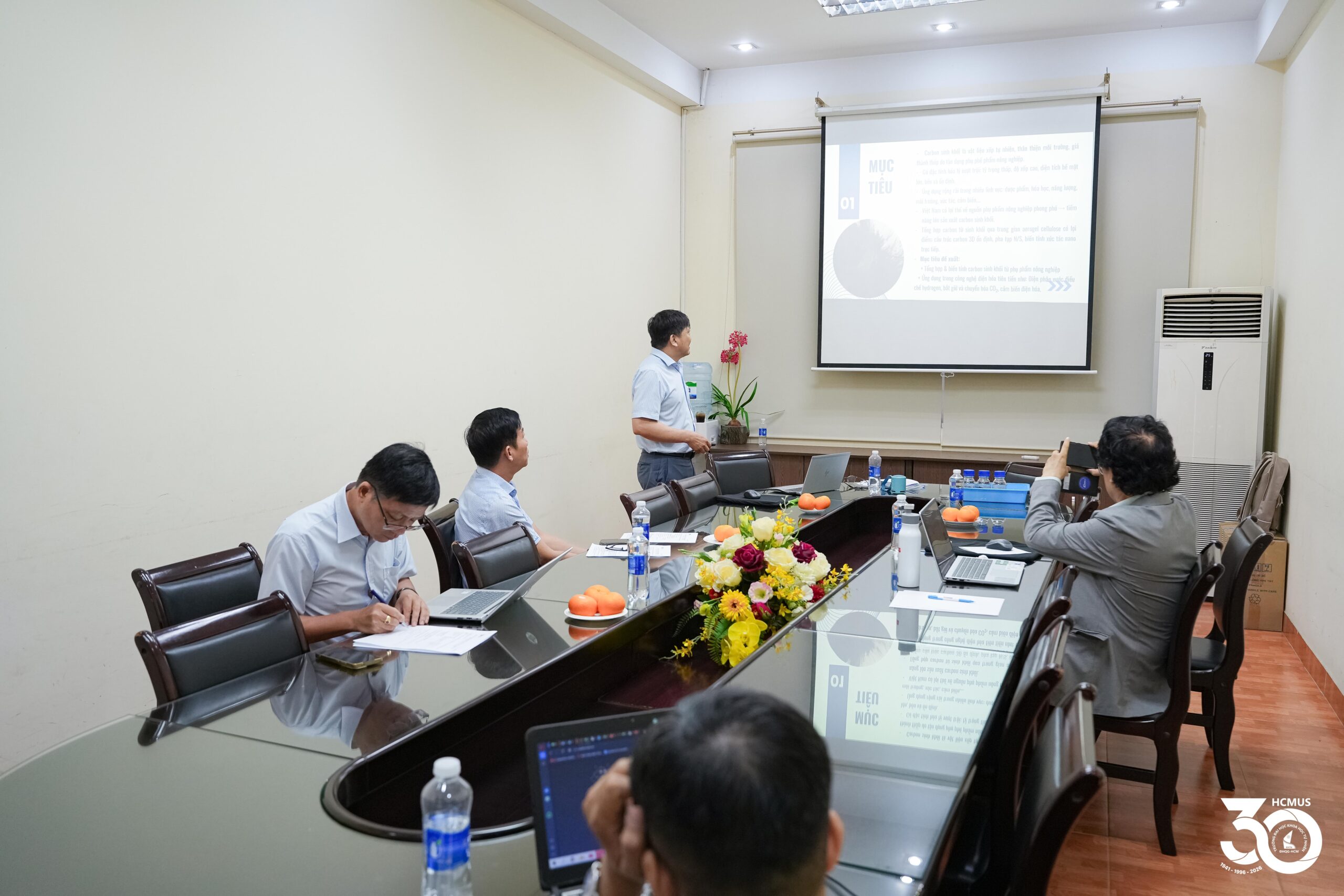
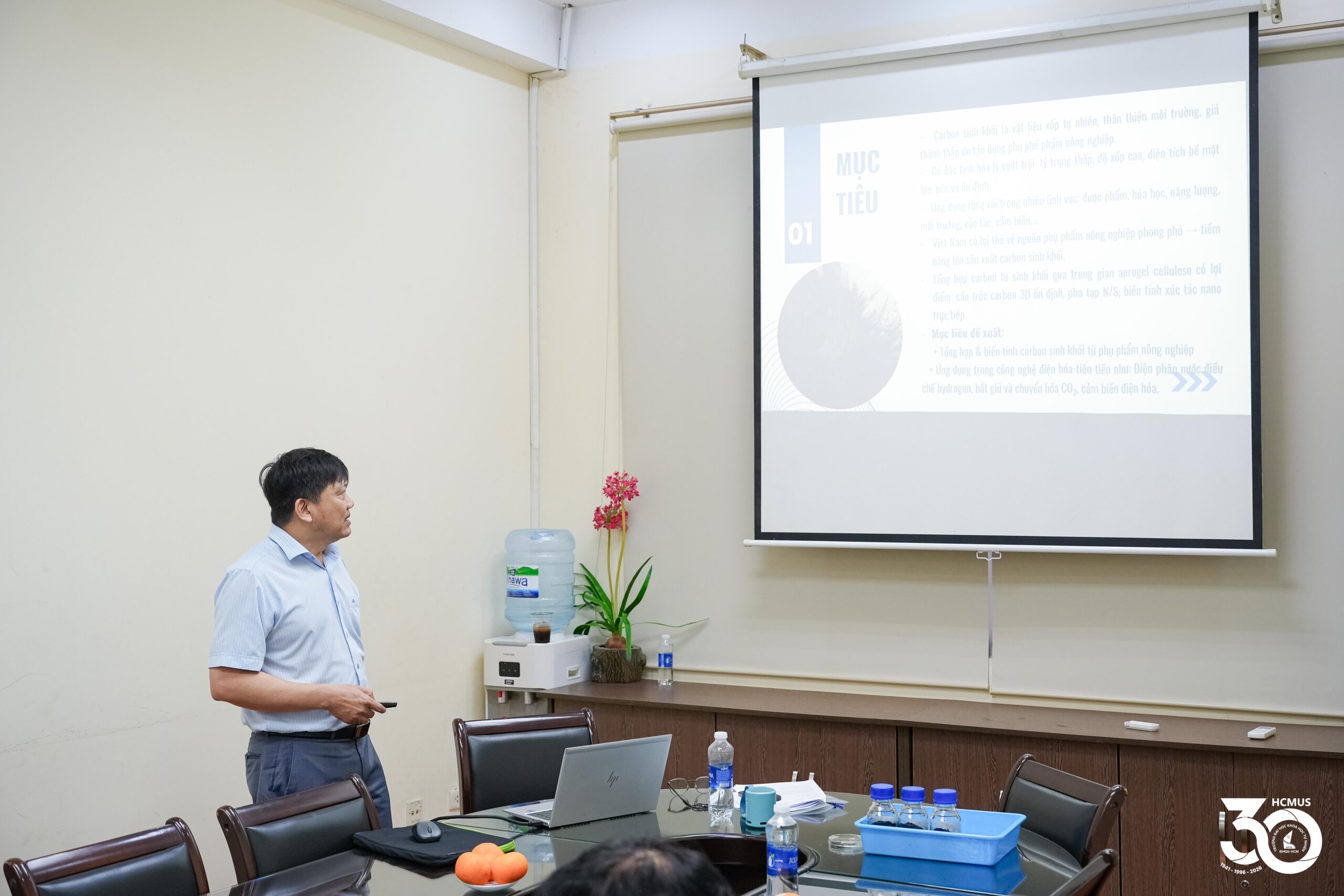
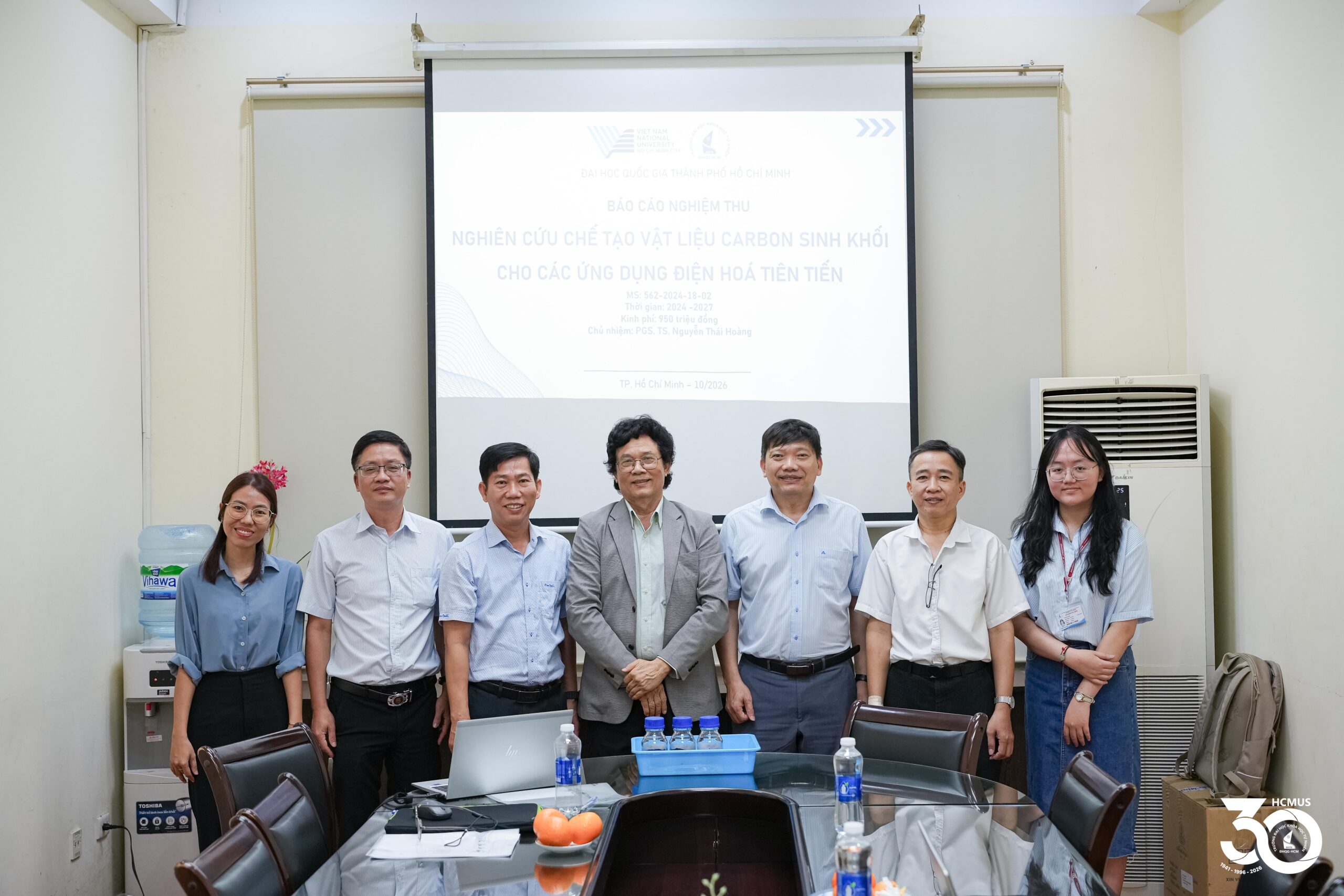
On 27 October, VNUHCM–University of Science (HCMUS) held an evaluation meeting for a research project investigating the fabrication of carbon aerogels from three common agricultural by-products in Viet Nam: sugarcane bagasse, corn cobs and peanut stems. The research aims to valorise agricultural biomass as a low-cost, environmentally friendly source of electrode materials for electrochemical technologies.
The project focused on the synthesis of carbon aerogels from three biomass sources: sugarcane bagasse, corn cobs and peanut stems. During the project, the research team successfully extracted cellulose from all three feedstocks, achieving purity levels of 90–99%. The cellulose was subsequently converted into cellulose aerogels with porosities of 84–93%. Through carbonisation, nitrogen and sulphur (N/S) doping using urea and thiourea, and functionalisation with metal nanoparticles, including Ni, Co, Cu and Au (30–100 nm in size), as well as metal oxides such as TiO₂, CuO, ZnO and NiFe₂O₄, the team produced carbon aerogels with specific surface areas ranging from 454 to 1,003 m²/g. These properties provide a basis for further research and development in electrochemical applications.
Building on the materials developed, the team fabricated porous carbon electrodes using PVA/GA binders, aiming to improve wettability and performance in electrocatalytic reactions. The results showed that electrodes incorporating Ni and Co nanoparticles exhibited activity towards the hydrogen evolution reaction (HER), maintaining stability over 12 linear sweep voltammetry (LSV) cycles and retaining 80% of the initial activity after 12 hours of measurement. For the CO₂ reduction reaction (CO₂RR), copper electrodes modified with ZnO and Cu demonstrated improved activity, with a reported overpotential of −349 mV. In capacitive deionisation (CDI), CuO-loaded carbon electrodes achieved a maximum NaHCO₃ adsorption capacity of 71.9 mg/g, indicating potential for further investigation in systems designed for the treatment and separation of carbon-containing compounds.
Beyond electrocatalysis, biomass-derived carbon aerogels were also investigated for the development of electrochemical sensors. The Ni@NiO/carbon aerogel electrode delivered stable glucose detection signals, demonstrated a linear response and showed selectivity in the presence of interfering substances. Meanwhile, the Au/carbon aerogel electrode enabled the simultaneous detection of dopamine and uric acid, as well as the detection of hydroquinone at low concentrations.
In terms of scientific and technological outputs, the project delivered four scientific reports in digital format and three groups of functional biomass-derived carbon materials as physical products. The findings were published in four articles indexed in Web of Science (WoS) and Scopus: three Q1 papers in Chemosphere, Materials Research Bulletin and Ceramics International, and one Q2 paper in the Journal of Chemical Technology & Biotechnology.
Alongside these research achievements, the project contributed to scientific workforce development, supporting one doctoral researcher, four master’s students who successfully defended their dissertations, 11 Chemistry graduates and four graduates in Chemical Engineering Technology.
Leave a Reply