

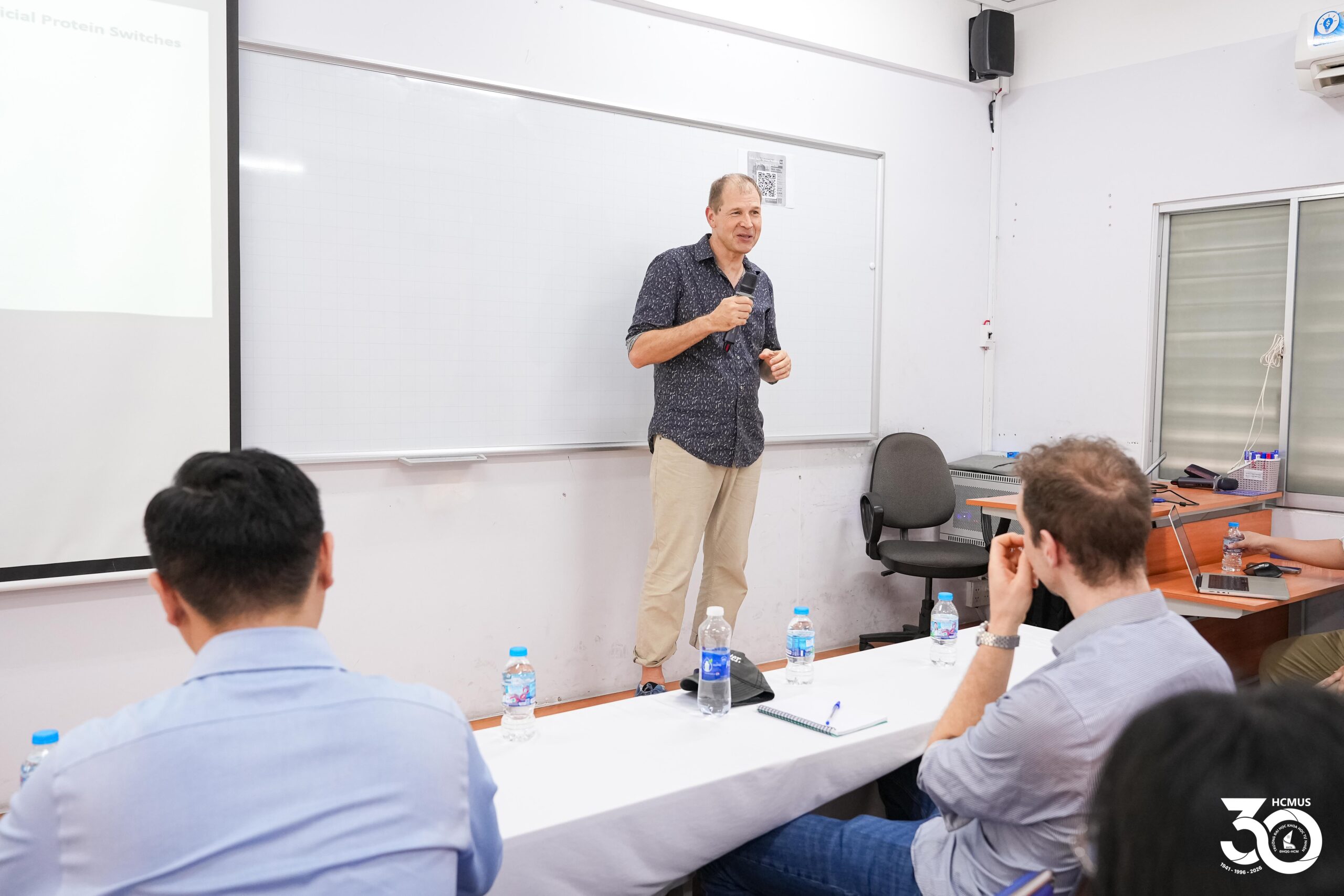
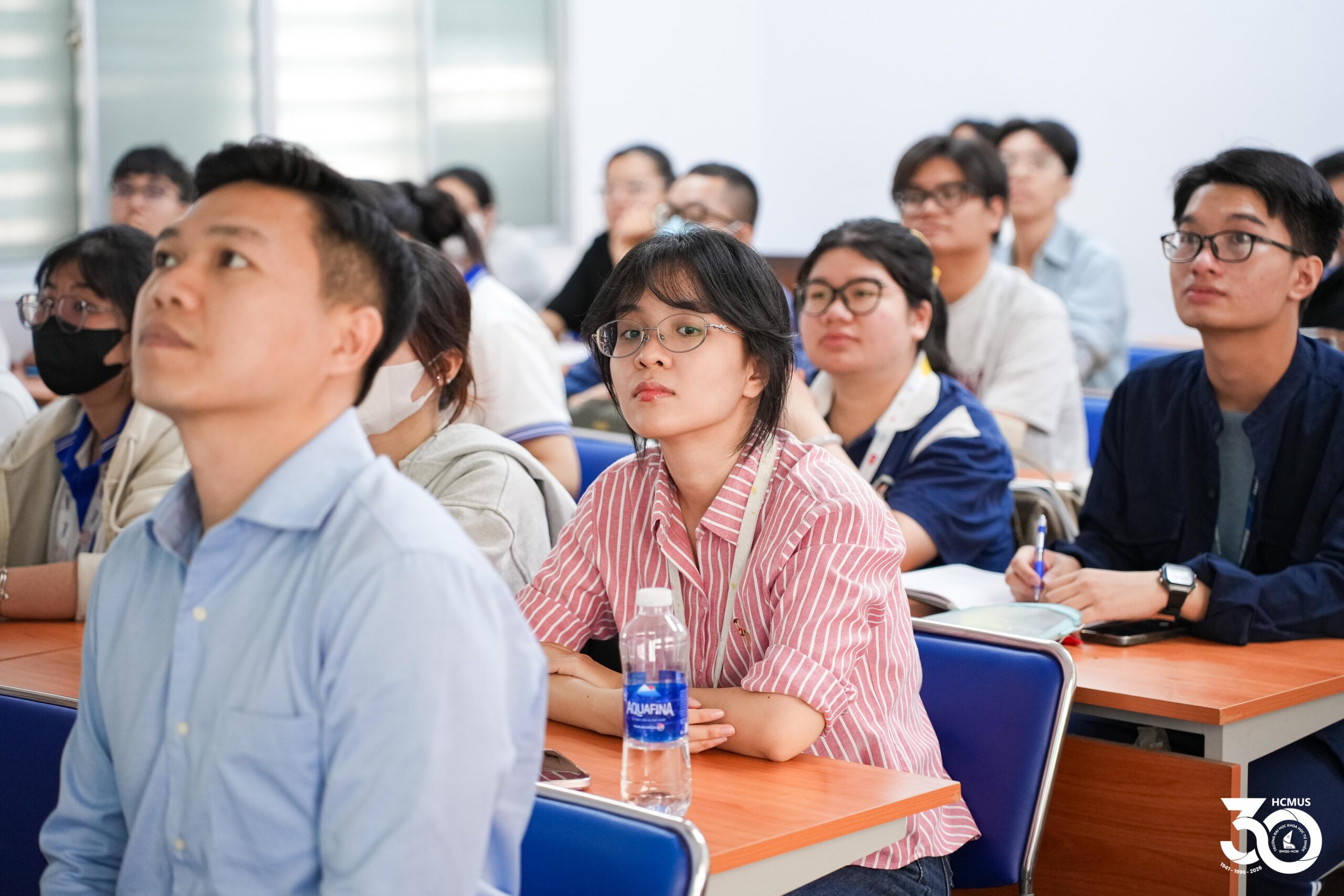
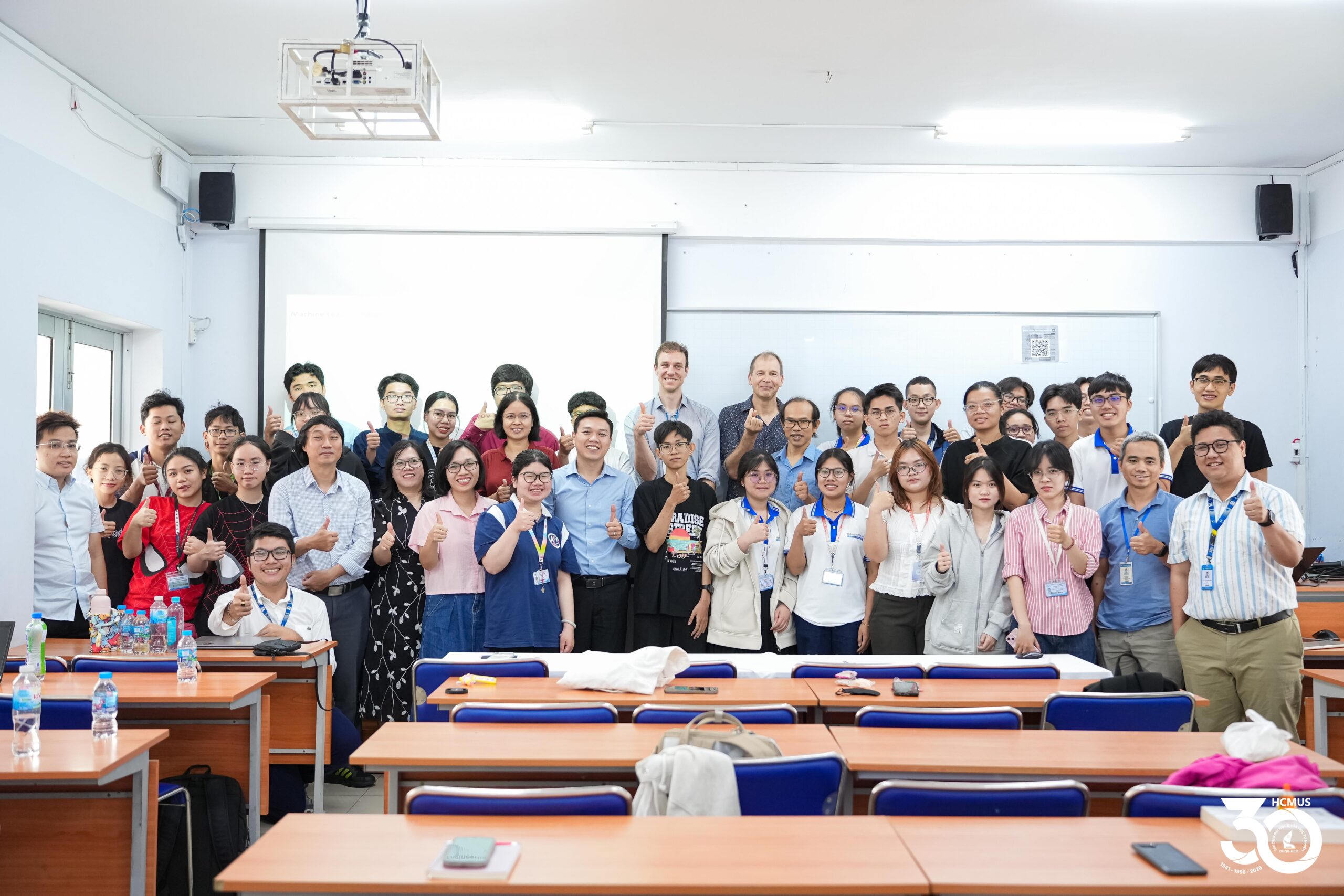
On 23 April 2026, the Faculty of Biology and Biotechnology at VNUHCM–University of Science (HCMUS) hosted an academic seminar featuring Professor Kirill Alexandrov from Queensland University of Technology, Australia. The event was attended by Faculty leadership, undergraduate and postgraduate students, and researchers across the field.
During the seminar, Professor Kirill Alexandrov delivered a keynote lecture entitled “Machine Learning Meets Cross-Eyed Protein Engineering: Building Artificial Protein Switches”. His presentation focused on the design of artificial allosteric regulatory proteins capable of transducing biochemical signals.
By integrating structure-based protein design with machine learning models, the research group has successfully developed artificial allosteric enzymes boasting high performance and a broad dynamic range. The incorporation of machine learning has significantly enhanced the development of fully synthetic biosensors, aimed at detecting proteins and small molecules within human biological samples.
Furthermore, protein “switches” with electrochemical outputs are utilised to construct sensing bio-electrodes. These allow for the conversion of molecular recognition signals into electrical currents, paving the way for the development of affordable point-of-care diagnostic devices.
The subsequent discussion session saw a range of enquiries regarding the operational principles of protein “switches”, machine learning approaches in protein design, and the broader implications for biological diagnostics. These exchanges clarified specific methodologies, providing attendees with a concrete vision of the field’s trajectory while offering guidance for student research and academic development.
This seminar serves as a vital academic forum to update the community on emerging research directions, whilst strengthening professional exchange and the connection between research and education within the biological and biotechnological sciences.
Speaker Profile
Professor Kirill Alexandrov currently holds the position of CSIRO–QUT Professor of Synthetic Biology at Queensland University of Technology, Australia.
He obtained a Master’s degree in Invertebrate Zoology from Leningrad State University (Russia) in 1989 and completed a PhD in Cell Biology at the European Molecular Biology Laboratory (Germany) in 1995. Subsequently, he spent over a decade at the Max Planck Institute of Molecular Physiology in Dortmund, serving as a Group Leader from 1999.
In 2008, he relocated to Australia to join The University of Queensland as an Australian Research Council (ARC) Future Fellow, before joining Queensland University of Technology in 2018 as the Inaugural Professor of Synthetic Biology.
Professor Kirill Alexandrov’s primary research interests lie in protein engineering for artificial sensing and biological signalling systems. His work also involves developing bidirectional interfaces between biology and electronics, targeting applications in diagnostics and biotechnology.
A pioneer in protein-based biosensors, Professor Kirill Alexandrov co-founded two biotechnology enterprises: JenaBioscience GmbH (Germany, 1998) and Molecular Warehouse Ltd (UK/Australia, 2015). The research group is widely recognised for numerous publications in international scientific journals and projects funded by the ARC and other prestigious scientific organisations.
Leave a Reply